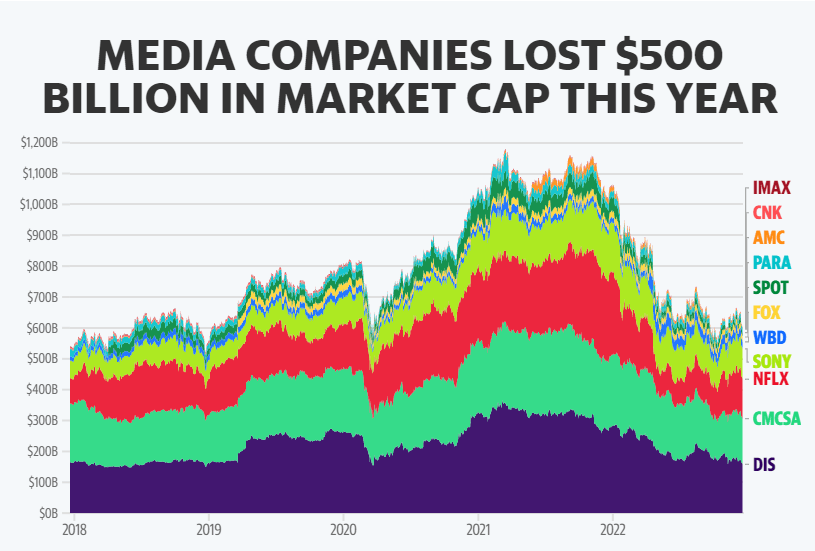
Media stocks lost over $500 billion in value this year — here’s what happens next

Rising costs, debt-ridden balance sheets, and a renewed focus on profitability weighed on the embattled sector as investors quickly punished companies struggling to turn a profit.

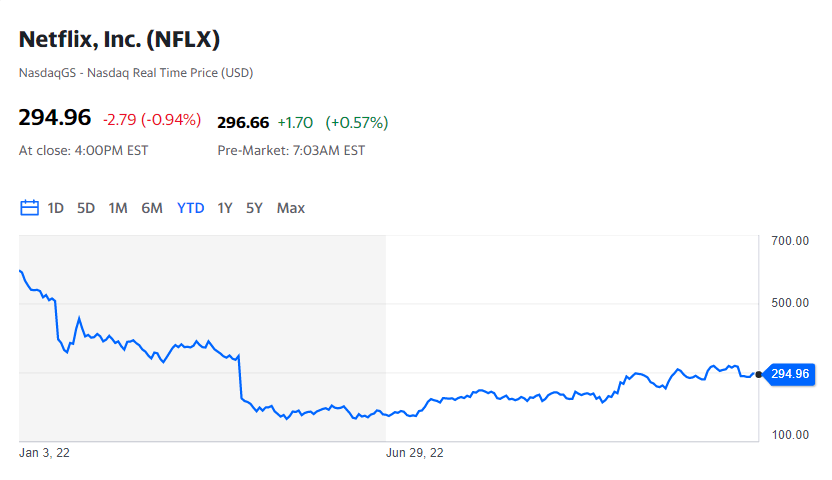
Netflix (NFLX) shares are down about 50% on the year, while companies like Warner Bros. Discovery (WBD) and Spotify (SPOT) have sunk more than 60% with Roku (ROKU) plummeting a whopping 80%.

Cable operators Fox (FOX) and Comcast (CMCSA) dropped roughly 20% and 30%, respectively, as Paramount Global (PARA) shares plunged more than 45%.

Disney (DIS), once a Wall Street darling, also slid 45% on the year, and the stock is heading toward its worst year since 1947 after the much-anticipated “Avatar” sequel missed opening weekend expectations to cap off a challenging year for the House of Mouse.

In this year alone, the stock market wiped a whopping $500 billion-plus in market capitalization from the world’s biggest media, cable, and entertainment companies with more pain expected in 2023 amid higher interest rates and an unfavorable macroeconomic environment.

So, what exactly happened — and what could happen next?
Wall Street’s profit push: ‘Time to be a real company’

2022 was a clear “soul searching” year for media after the industry experienced a bumpy ride throughout the pandemic with record highs and jarring lows.

As the “stay at home” trade ran its course, peak subscriber penetration levels in the U.S. and Canada resulted in streaming companies quickly seeing growth flatten.

Netflix, the long-time leader of the streaming wars, lost subscribers for the first time in its history as its market cap sank from more than $267 billion at the end of 2021 to roughly $130 billion.

Similarly, NBCUniversal’s Peacock experienced zero growth in its second quarter, although subscribers rebounded in Q3 with 2 million net additions.
Stalling subscriber growth has led to heightened criticism of production budgets, which have sharply increased as competition intensifies. Netflix committed $18 billion to content alone in 2022 while Disney upped its budget by $8 billion this year to $33 billion.

Among companies that have begun to pivot from linear to streaming (excluding platforms like Netflix, Amazon, and Apple), direct-to-consumer content spending jumped from $2.7 billion in 2019 to $15.6 billion in 2021, according to Wells Fargo data, cited by Variety.

That number is expected to balloon to nearly $24 billion this year — despite mounting streaming losses.

Disney’s direct-to-consumer division shed a whopping $4 billion-plus in its fiscal 2022, which ended on October 1. Meanwhile Paramount told investors streaming losses would total about $1.8 billion this year — higher than Wall Street expectations.

Warner Bros. Discovery, which has seen its market cap cut in half amid its messy restructuring efforts, reported free cash flow of negative $192 million in the third quarter, compared to $705 million in positive cash flow the year prior. The company now plans to take on $3.5 billion in content impairment and development write-offs by 2024.

Ad-supported ‘pivotal’ for industry

Amid the race to profitability, advertising has become one potential bright spot for investors — despite the global slowdown in ad spending.

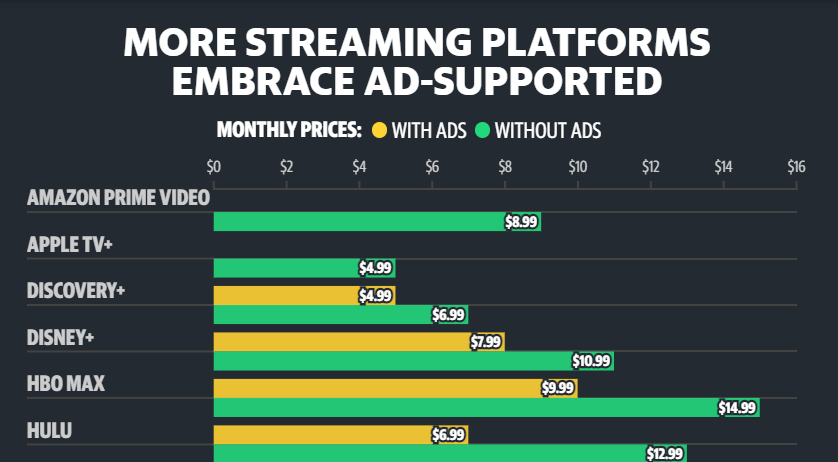
Netflix and Disney jumped on the ad-supported bandwagon this year, joining Warner Bros. Discovery’s HBO Max, NBCUniversal’s Peacock, and Paramount Global’s Paramount+.

Netflix rolled out its $6.99 offering in November, while Disney+ followed one month later at a price point of $7.99. Wall Street analysts remain largely bullish on the profitability aspects of ad tiers, while advertising experts have referred to the debuts as a make-or-break moment for the media industry.

“It is absolutely a pivotal moment for the industry,” Kevin Krim, CEO of advertising measurement platform EDO, previously told.

“I think what we have learned as an industry is that there’s a limit to the number of consumers out there that will pay,” Krim said. “Advertising is a really smart way to subsidize those subscription fees.”
Industry experts agree offering lower-cost, ad-supported options serve as an important hedge against churn — something all streamers want to avoid amid increased competition.

“I’m a big fan of giving consumers an option for an ad tier,” told Jon Christian, EVP of digital media supply chain at Qvest, the largest media & entertainment-focused consulting company.

Christian added data will be a big driver (and potential money maker) when it comes to more targeted advertising in 2023: “Data can drive up the pricing of the different ads they’re pushing on the platform.”

Still, the benefits of ad-supported will likely take time to mature.

Netflix’s ad tier already appears to be undergoing some serious growing pains — including reports of insufficient sign-ups and failed viewership guarantees. Analysts, however, caution it’s still early days.

Analysts eye next media merger
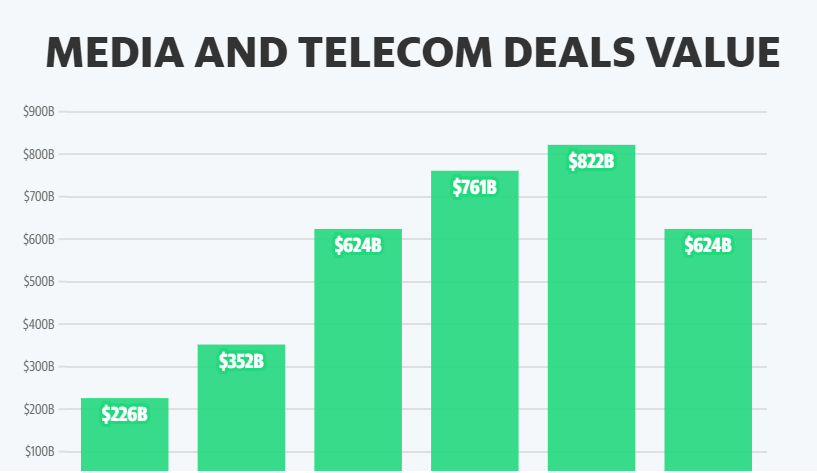
Coupled with a greater focus on content spend and advertising, investors should also expect more media merger activity next year.

Wells Fargo analyst Steve Cahall wrote in a recent note: “Our 2023 predictions indicate Media and Cable sectors reacting to generally harder times, both cyclical and structural. Tough times mean tough decisions.”

Possible acquisition targets in 2023 and beyond include the embattled Warner Bros. Discovery.

Lionsgate’s film and TV studio, which the entertainment giant plans to spin off into a separate company, will also be for sale, while AMC Networks (AMCX) continues to undergo a restructuring that could result in an acquisition.

Needham’s Laura Martin wrote in a recent client note Paramount could be attractive to unload, while smaller players like WWE (WWE), Curiosity Stream (CURIW), and Chicken Soup for the Soul (CSSE) will likely sell due to their size.

Disney CEO Bob Iger, who returned to the media conglomerate to much fanfare in November, will also face a slew of decisions — including what to do with notable assets like Hulu (sell it to Comcast?) and sports behemoth ESPN (spin it off?).

Layoffs, hiring freezes hit big media
Amid greater profitability concerns, media giants have enacted mass layoffs and hiring freezes in an attempt to stop the bleeding. More than 3,000 jobs have been cut through October this year, according to data from Challenger, Gray & Christmas, cited by Axios.

Netflix laid off about 150 positions of the streamer’s 11,000 workforce in May, blaming the headcount reduction on “slowing revenue growth” and a greater depletion in spending.

Earlier this month, Warner Bros. Discovery revealed prominent Discovery executives will be exiting the company after it axed CNN+, nixed more CNN staffers and slashed 14% of its HBO Max workforce this year.

So far, the company has eliminated a reported 1,000-plus jobs across units as WBD CEO David Zaslav doubles down on restructuring efforts, which have also included scrapped projects and programs.

Paramount Global began to cut jobs in November, targeting its ad sales group, according to Deadline, while AMC Networks (AMCX) announced plans to lay off about 20% of its U.S. workforce amid CEO Christina Spade’s exit.

AMC Chairman James Dolan reportedly told employees the network has struggled to offset cable declines as cord cutting accelerates, referencing the company’s owned-streaming entities like AMC+ and horror platform Shudder.

Similarly, Comcast’s cable unit made job cuts in November, while Roku (ROKU) slashed 200 jobs, or 5% of its workforce, shortly after its third quarter earnings results.

Theatrical comeback still TBD

The theatrical industry continued to recover from pandemic losses in 2022 — although whether a complete comeback will be made remains to be seen.

Films like “Top Gun: Maverick” broke records, while Marvel’s “Black Panther: Wakanda Forever” and “Doctor Strange in the Multiverse of Madness” easily nabbed $100 million-plus domestic openers.

Still, Disney’s “Avatar: The Way of Water” secured just $134 million in domestic markets over its three-day opening weekend, missing expectations and sending Disney shares to their lowest level since March 2020.

Despite the miss, theater executives championed the debut, surmising the movie will steadily add box office dollars over the holidays and well into 2023.

Streaming giants have embraced the theatrical, as well, with Netflix’s “Knives Out: Glass Onion” enjoying a successful limited theatrical release over Thanksgiving week, while Amazon will reportedly invest $1 billion to produce 12 to 15 movies a year exclusively for theaters.

Overall, the domestic box office is estimated to bring roughly $7.4 billion for the year, according to Box Office Pro. Although that number still lags pre-pandemic figures by about 30%, there is hope that next year’s more beefed-up release schedule will help close the gap.

Source: canadatoday.news
Exclusive-Tesla to run reduced production schedule in Shanghai in January, plan shows

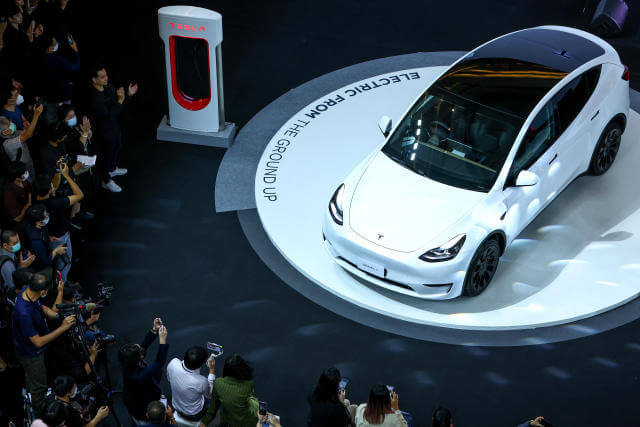
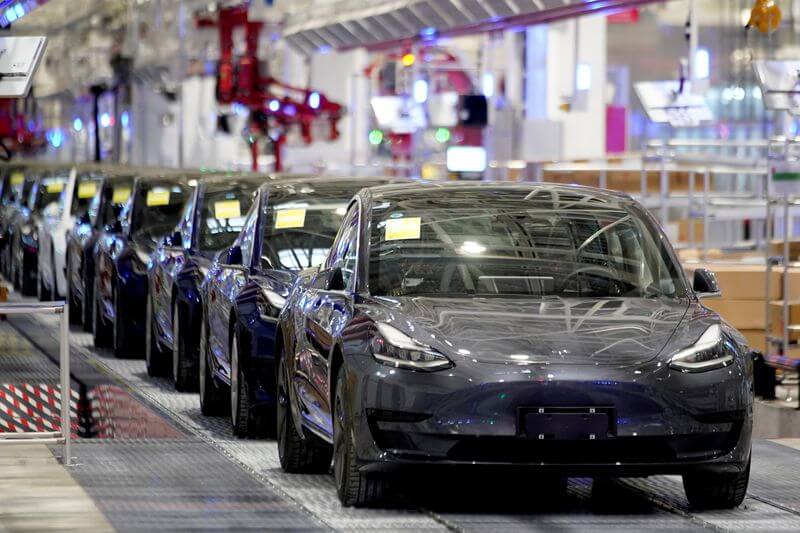
Tesla plans to run a reduced production schedule at its Shanghai plant in January, extending the reduced output it began this month into next year, according to an internal schedule.

Tesla will run production for 17 days in January between Jan. 3 to Jan. 19 and will stop electric vehicle output from Jan. 20 to Jan. 31 for an extended break for Chinese New Year, according to the plan seen by Reuters.

Tesla did not specify a reason for the production slowdown in its output plan. It was also not clear whether work would continue outside the assembly lines for the Model 3 and Model Y at the plant during the scheduled downtime. It has not been established practice for Tesla to shut down operations for an extended period for Chinese New Year.

Tesla suspended production at its Shanghai plant on Saturday, pulling forward an established plan to pause most work at the plant in the last week of December, Reuters has reported.

Tesla’s latest production cuts at Shanghai come amid a rising wave of infections after China stepped back from its zero-COVID policy earlier this month. That move has been welcomed by businesses although it has disrupted manufacturing operations outside Tesla.

Like other automakers, Tesla has also faced a downturn in demand in China, the world’s largest auto market. Earlier this month, Tesla offered an additional incentive for buyers taking possession of vehicles in December. The company has cut prices for Model 3 and Model Y cars by up to 9% in China, in addition to a subsidy for insurance costs.

The Shanghai factory, the most important manufacturing hub for Elon Musk’s electric vehicle company, kept normal operations during the last week of December last year and took a three-day break for Chinese New Year.

The Jan. 21 to Jan. 27 period in 2023 is a public holiday in China for Chinese New Year.

Tesla’s Shanghai plant, a complex that employs some 20,000 workers. accounted for more than half of Tesla’s output in the first three quarters of 2022.

Tesla has set a target for growth of 50% in output and electric vehicle deliveries in 2022. Analysts expect output to fall short of that goal at closer to about 45%, based on forecasts for the soon-to-end fourth quarter.

Source: reuters.com

Samsung Elec to expand chip production at largest plant next year – media

Samsung Electronics plans to increase chip production capacity at its largest semiconductor plant next year, despite forecasts of an economic slowdown, a South Korean newspaper reported late on Sunday.

The move contrasts with the scaling back of investment by rival chipmakers amid falling demand and a glut of chips.

Analysts have said that Samsung’s persistence with investment plans will likely help it take market share in memory chips and support its share price when demand recovers.

Samsung plans to expand its P3 factory in Pyeongtaek, South Korea, by adding 12-inch wafers capacity for DRAM memory chips, the Seoul Economic Daily reported, citing unnamed industry sources.

It will also expand the plant with additional 4-nanometre chip capacity, which will be made under foundry contracts – that is, according to clients’ designs – the paper said.

P3, which started production of cutting-edge NAND flash memory chips this year, is the company’s largest chip manufacturing facility.

Samsung is planning to add at least 10 extreme ultraviolet machines next year, the newspaper said.

Samsung declined to comment on the report.

In October it said it was not considering intentionally cutting chip production, defying the broader industry’s tendency to scale back output to meet mid- to long-term demand.

“We plan to stand behind our original infrastructure investment plans,” Han Jin-man, executive vice president of memory business at Samsung, said then.

In contrast, memory chip rival Micron Technology Inc said last week it would adjust down its investments in fiscal 2023 to between $7 billion and $7.5 billion, compared with $12 billion in fiscal 2022. It would also be “significantly reducing capex” plans in fiscal 2024, it said.

Taiwanese chipmaker TSMC in October cut its 2022 annual investment budget by at least 10% and struck a more cautious note than usual on upcoming demand.

“The chip industry downturn will add to the difficulties of No. 2 and below chip companies, and have a positive impact on the market control of top companies such as Samsung,” Greg Roh, head of research at Hyundai Motor Securities, said on Monday.

Source: reuters.com

4 Stocks You Can Buy on Sale Right Now

Some of the biggest names in the world had a lousy year which makes them perfect additions to your portfolio.

Stock price often does not reflect the actual performance of a company. Sometimes bad companies see their share price climb for dumb reasons (like people touting the stock of social media for reasons that have nothing to do with its actual business). In other cases, share prices fall for macroeconomic or speculative reasons that also don’t actually tie to the brand’s results.

As a long-term, buy-and-hold investor (someone who intends to hold the stock at least three years, but likely longer) these market disconnects create buying opportunities. Essentially, you want to find companies that are performing well or are set up to perform well, where the share price has been lagging.

The past year created a number of incredible value purchases where good companies have seen their share price fall in 2022, but it’s hard to imagine that staying the trend over the next few years.

1. Starbucks

In tough economic times, Starbucks (SBUX) – may see some customers cut back, but others will see a fancy coffee drink as an affordable luxury. Shares in the coffee chains are trading nearly 16% down year-over-year, but that price reflects labor issues, executive turmoil, and general concern over the economy, not the demand for the chain’s products.

Starbucks leads its category and has a well-defined business model. After years spent focusing on execution, the chain has a major plan to make its process more efficient while also cutting costs, and continuing to innovate.

2. Target

Target (TGT) – shares have lost nearly 40% of their value in 2022. That drop happened because the chain saw its margins fall and got caught with excess high-priced inventory it had to sell off at a discount (something that likely gave it a stronger bond with its customers).

Yes, Target’s margins dipped but sales and foot traffic increased. There has been a battle for retail customers and “Tar-Jay,” as some of its fans jokingly refer to the chain has clearly won that battle.

3. Walt Disney

In a year when a Walt Disney (DIS) resort vacation became even more expensive (and profitable for the company) and Disney+ became the number two streaming service, the company’s stock has struggled. Disney’s share price dipped about 43% over the past year due to concerns over its movie business, questions about now-former CEO Bob Chapek, and political battles with Florida Governor Ron DeSantis.

Investors were also worried about losses in the streaming business, but those losses were in line with what the company had told investors to expect. And, yes, the movie business may never come back, but Disney has better intellectual property than any three, and maybe all of its rivals put together.

Consumers will pay for Marvel, Star Wars, Pixar, and Disney content. It may take the company a while to figure out the best platforms, but ultimately, the company with the best content will dominate and that’s Disney by a large margin.

4. Microsoft

Microsoft (MSFT) – might be the most surprising name on this list. The company does face some regulatory concerns over its acquisition of Activision Blizzard (ATVI) – but it’s not like the software/cloud giant’s fortunes rest on that. It’s also possible that broad economic concerns have weighed on the company, but businesses won’t be dropping the Office suite because of tough economic times.

The reality is that Microsoft sells/licenses products that are deeply rooted into companies’ ecosystems. Cutting back or getting rid of them is basically impossible in the short-term which makes Microsoft essentially recession proof.

Source: finance.yahoo.com

Tesla doubles rare discounts on mainstay vehicles amid demand concerns

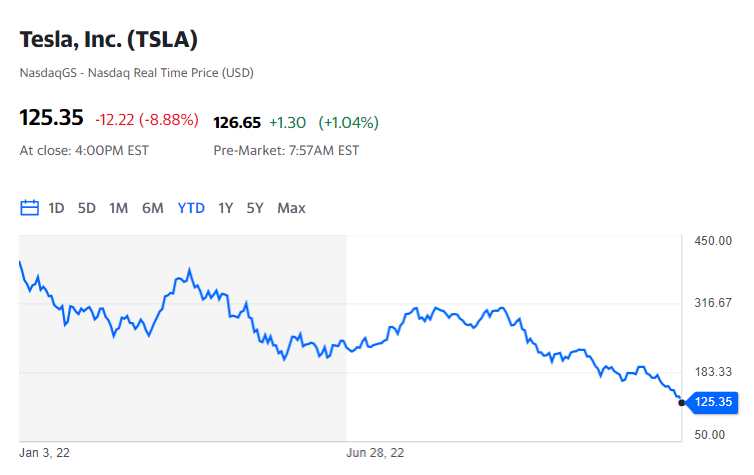
Tesla Inc is offering $7,500 discounts on Model 3 and Model Y electric vehicles (EV) delivered in the United States this month, its website showed on Wednesday, amid concerns the automaker is facing softening demand as economies slow and EV tax incentives loom.

That is up from the $3,750 credit it has offered on Model 3 and Model Y vehicles delivered before the end of the year. It has also recently started offering free supercharging for 10,000 miles (16,093 kms) for the December vehicles.

The latest discount came just days after the U.S. Treasury Department delayed restrictions on EV incentives until March, meaning Teslas and other U.S-made electric vehicles are likely to qualify for the full $7,500 credits temporarily.

Customers have canceled their orders and held off their purchases until the new credits take effect in January, weighing on Tesla demand.

Analysts also worry that rising interest rates and CEO Elon Musk’s controversial Twitter management could hurt the Tesla brand and sales.

“The fact they seem to be cutting price to increase deliveries volumes doesn’t raise confidence, particularly at a time where we see increasing competition,” Craig Irwin, a senior analyst at ROTH Capital Partners, said.

The rare discounts follow a series of price hikes over the past couple of years by the automaker, which blamed supply chain disruption and inflation.

Tesla is also offering $5,000 credit in Canada on Model 3 and Model Y vehicles delivered before the end of the year. The U.S. automaker has also given a discount of 6,000 yuan ($860) on some models in China to the end of 2022.

Tesla in October said it would miss its vehicle delivery target this year, but downplayed concerns about demand after its revenue missed Wall Street estimates.

Source: finance.yahoo.com

Netflix stock is up 65% since July, but the company faces 5 big problems in 2023

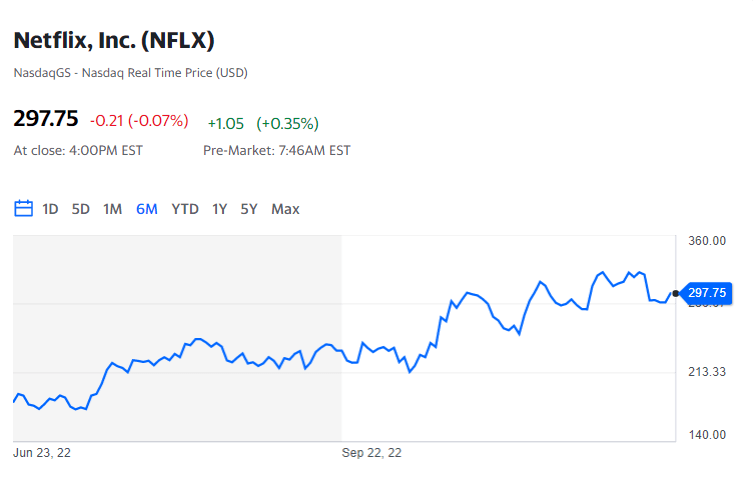
Netflix (NFLX) shares have been on a tear over the last six months of the year.

But investors will have plenty to worry for the company in 2023, according to one Wall Street analyst.

Needham’s Laura Martin argued in a new client note on Thursday the stock will battle several headwinds in the new year including slowing subscriber growth and increased pressure on its key financial metric, average revenue per user, or ARPU.

Shares of Netflix, down about 50% since the start of the year, have climbed more than 65% over the past six months as industry watchers see content improvements decreasing churn in 2023, while investors remain optimistic by the platform’s foray into advertising — despite recent negative headlines surrounding its November debut.

Martin, however, did not seem convinced by the recent rally, arguing in her note: “NFLX’s peak subs may be behind it, because churn is rising for all [over-the-top platforms].”

She added if Netflix does report subscriber growth in 2023, those users will likely come from low-ARPU regions overseas, while subscriber losses will stem from high-ARPU geographies like the U.S. and Canada, which will weigh on revenue growth.

The analyst, who maintained a Hold rating on the stock, lowered her full-year 2023 revenue estimate by 7% to $33.4 billion. She also lowered expectations for adjusted EBITDA to $6.5 billion and GAAP EPS to $9.31, figures that are 15% and 20% below the firm’s latest estimates, respectively.

Will ad tier hurt Netflix revenue?

Recent ad tier struggles also point to downside risks, Martin said, citing a new study by subscription analytics firm Antenna, which showed the streaming giant’s $6.99 ad-supported offering was the least popular tier of its service during the month November.

The ad tier, which officially debuted in U.S. markets on November 3, accounted for just 9% of Netflix sign-ups during the month. About 57% of those ad-supported subscribers re-joined the service or signed up for the first time, while 43% traded down to the cheaper plan, Antenna data revealed.

Antenna’s study comes after Netflix’s stock lost nearly 9% last Thursday, its biggest intraday drop since April, after a report from Digiday said the streaming giant fell short on viewership guarantees it made to advertisers for the ad tier.

Martin warned Netflix’s 2023 bull case hinges on a successful ad-supported rollout, which makes the recent reports especially unfavorable heading into the new year.

Finally, the analyst — who previously argued Netflix’s ad agreement with Microsoft suggests a future acquisition — described today’s combative regulatory environment as a potential 2023 headwind.

Martin pointed to the FTC’s recent antitrust lawsuit against Microsoft (MSFT) and its $69 billion acquisition of “Call of Duty” publisher Activision Blizzard (ATVI), writing the lawsuit “destroys NFLX shareholder value in 2 ways — making it less likely that MSFT bids for NFLX and/or MSFT is distracted from its AdTech commitments for NFLX’s ad-tier during 2023.”

Source: finance.yahoo.com

6 big reasons Apple stock is a must buy for 2023: analyst

Investors in Apple have had an un-Apple-like year, but at least one analyst thinks that will change in 2023.

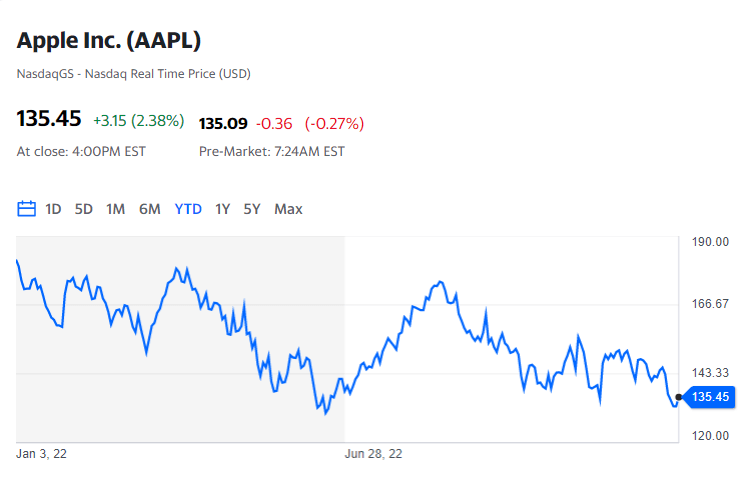
The tech giant’s stock has dropped 25% in 2022, lagging the S&P 500’s 19% drop.

The decline comes despite Apple often being viewed as a safe-haven investment, as it boasts a formidable balance sheet flush with cash and a steady stream of repeatable services income.

But just like other large companies, the volatile global economic backdrop has hit Apple in the form of slowing iPhone and accessory sales, as well as production delays out of COVID-19-stricken China.

Apple’s stock now trades on a forward price-to-earnings ratio of 22, a roughly 21% discount to its historical average. At 16 times forward enterprise-value-to-EBITDA, Apple’s stock trades at a 17% haircut to its historical norm.

The more compelling valuation on mighty Apple has caught the attention of long-time tech analyst Jim Suva at Citi.

“We believe demand for Apple’s products and services is likely to remain resilient throughout FY23. We do recognize that regulatory risks remain a major overhang on the stock, but we view these as headline risk rather that fundamental risk. Such headlines could provide a near-term stock pullback which we would view as a buying opportunity for Apple shares,” Suva wrote in a new 20-page report to clients.

Suva reiterated a buy rating on Apple with $175 price target, which assumes about 30% upside from current levels.

Added Suva, “Apple’s current market value does not reflect new product category launches. This will change with the launch of the new AR/VR headset in 2023 and foldables in 2024.”

Here are the six factors behind Suva’s bullish 2023 call on Apple.

  1. Here comes India: A little appreciated factor in Apple’s future growth is India, Suva says. The biggest bullish factor on India, Suva says, is the growing wealth of the country’s population. “India’s upper-mid and high-income middle class, with incomes of $8.5K+, is expected to double from currently representing 25% of its households to more than 51% of total households (~200 million). These households are expected to increase spending by six times from representing 37% of current spending ($1.5 trillion) to 61% of $6 trillion by 2030. Middle-income and high-income households would drive nearly $4 trillion of incremental consumption spend by 2030. Overall, there will likely be nearly $2 trillion of incremental spend on affordable, mid-priced offerings, in parallel with $2 trillion incremental spend led by consumers upgrading to premium offerings or adding new categories of consumption,” Suva says.
  2. iPhone sales growth: Suva says sentiment on iPhone demand has gotten too bearish. “Investor sentiment across consumer tech hardware is very dour, with many believing that the strong growth seen overall in iPhones over the past two years (+23% revenue compound annual growth rate) is likely to see sharp declines ahead as macro inflationary pressures take a bite out of consumer spending. We do not believe this is the case, in other words, we do not expect a repeat of FY2016 or FY2019 when revenues declined by ~10-15%,” Suva writes. The analyst uncorks several reasons for his more optimistic view. “Our view is that the installed base of Apple’s iOS ecosystem is significantly larger now, implying an installed base at 1 billion plus iPhone users. Additionally, our research does not indicate smartphone replacement rates are lengthening (compared to recent levels) and are holding steady, and in some cases even shortening overall,” Suva adds.
  3. Services sales upswing: Suva’s research shows Apple’s services sales growth has cooled in 2022, in part due to a slowing economy. But that may change in 2023. “We expect price increases that were implemented in the last quarter to take effect in the ensuing quarters and will drive revenue growth ahead,” Suva says on the services business.
  4. Those new products: “We expect Apple to launch an AR/VR headset in 2023,” Suva says. The analyst points to improvements in 5G connectivity and a competing offering from Meta’s Oculus as key reasons Apple will finally enter the market. Any product announcement along these lines could propel the stock, Suva thinks.
  5. Regulatory risk overblown: Recent reports contend that to comply with the Digital Markets Act in Europe, Apple may allow alternative app stores on its iPhones and iPads. Suva believes the impact to Apple’s dominant app-store business is overblown. Says Suva: “In our view, there are several factors that may limit the impact from these off-store billing options including consumer behavior which in our view tends to be sticky, especially as it relates to the ability to securely pay and manage their subscriptions in one place.”
  6. The cash giveaways: Suva thinks Apple is poised to drop the mic when giving cash back to investors next year. “With free cash flow of ~$110 billion plus per year and net cash of $49 billion (as of year end FY22), we expect Apple’s cash chest to support at least $110 billion plus in shareholder returns per year, amounting to 4-5% of its current market cap in the form of buybacks and dividends. In spring 2023, we expect Apple to announce an incremental stock buyback of $85 billion after deploying ~$90 billion in FY2022. We also expect the company to raise its dividend by 10%,” Suva writes.

Source: finace.yahoo.com

Review: What it’s like to drive GMC’s new $100,000+ Hummer EV

The Hummer EV is an earthmoving, behemoth of a pickup that is everything most EV buyers are not trying to be – brash, in your face, and intimidating.

But when they hear it’s electric, their ears sort of perk up.

The Hummer EV, in Edition 1 trim as tested, is a fully loaded version of GMC’s top of the pyramid truck. It has 3 motors pumping out 1000 horsepower, features an 800-volt EV platform with massive Ultium battery (212.7 kWh), and has a range of around 350 miles.

The Edition 1 costs a Hummer-size $112,839 as tested, but you do get a lot for the money. Cheaper versions of the Hummer EV will start at around $80,000, GMC (GM) says.

The design

The big, bold exterior design of the Hummer in an exercise in non-restraint. One only need look at the massive light bar in the front with the glowing HUMMER EV printed on it. The truck is also over a foot wider than a Toyota Camry.

The bruising, bold look starts at the front, which is unmistakable Hummer, hearkening back to the old H1 and H2 of years past. The hulking front end with nearly flat windshield—with three windshield wipers—flows back to the full-size four door cab, and features buttress-like C-pillars that form the upper part of the truck bed.

Our tester continued the out of this word look with two massive 35-inch off-road tires in the pickup bed, capped off with GMC’s MultiPro tailgate that can fold in several stages, with one part incorporating a KICKER audio system and speakers for outdoor tunes.

Inside the Hummer is all business – lots of right angles and hard edges, nothing rounded or curved to speak off. A prominent floating touchscreen display houses GMC’s infotainment system, which uses a Hummer specific graphical background design, mimicking the surface of the moon. There are other moon references in the vehicle, from the floor mats to the speaker covers, echoing what the GMC Hummer team dubbed their moonshot vehicle.

The drive

Hummer almost the size of a medium-duty commercial vehicle.—on New York City streets was agita inducing.

The nearly 10,000-pound Hummer was somewhat nimble; its EV powertrain made accelerating and stopping with its regenerative braking system a smooth affair. Air suspension ate up potholes when encountered, and the vast array of cameras helped with visibility.

Sure there were a couple scary moments when trying to weave through heavy traffic, or the all to common squeezing around a double-parked car on an NYC side street. But the Hummer includes rear-wheel steer to reduce its turning radius, and a party trick known as “crabwalk,” to maneuver when confines are tight, like on an off-road trail. (I actually used crabwalk to parallel park on a narrow city street.)

But out of the city is where the Hummer shined. Sitting high up like a full-size pickup, the Hummer offers a commanding view of the road. With 1000 horsepower on tap, zooming past smaller cars and weaving around traffic felt like we were breaking the laws of physics.

Yes – it’s a capable truck, and we didn’t even have the chance to take if off road and use those 35-inch tires to good use. But the hummer is more than its physical presence. It’s GM’s way of showing what’s possible with EVs, and showing a skeptical public that an EV can be the biggest, baddest thing on the road.

“Hummer bordered on an evil brand when GM finally retired it,” my co-pilot Newman said about the brand’s once reviled history. “Environmentalists despised it because it was so needlessly obnoxious, and it got single-digit mpg. It had to be the most inefficient vehicle there was when it stopped production in 2010.”

But with the Hummer being all electric, those legacy issues are now gone. “It still might be inefficient, but there are no greenhouse gasses coming out the back,” Newman added. “They’re taking a sin brand and turning it into a virtuous brand.”

And that might be GM’s real moonshot. Taking the Hummer brand out of the dustbin of history, and making it king of the hill across all of GM’s truck offerings – electric or not.

Source: finance.yahoo.com

A Bull Market Is Coming. 3 Stocks to Buy Like There’s No Tomorrow

Will 2023 bring a new bull market?

For investors, 2022 came in with a bang, but it’s set to end with a whimper.

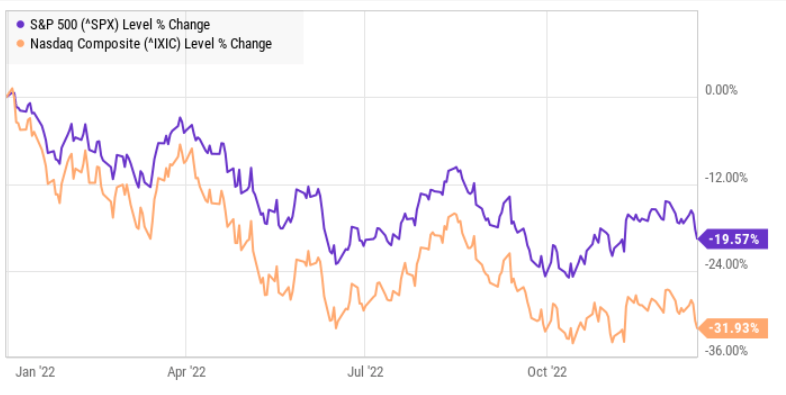
With just two weeks left to go in the year, the S&P 500 is down 20% year to date, while the Nasdaq has lost 32%.

Investors holding out for a Santa Claus rally may have gotten their hopes dashed by the Federal Reserve last week, which raised interest rates another 50 basis points and also lifted its forecast for interest rate hikes next year, calling for rates to rise another 75 basis points, which added to fears that the economy will fall into a recession next year.

No one knows what 2023 holds for the stock market, but we do know one thing. A bull market will come eventually, just as it has after every bear market in the history of the U.S. stock market, including the Great Depression, the financial crisis of 2008 and 2009, and the coronavirus pandemic crash.

When the next bull market comes, you’ll want to have these three stocks in your portfolio.

1. Pinterest: A unique opportunity in social media

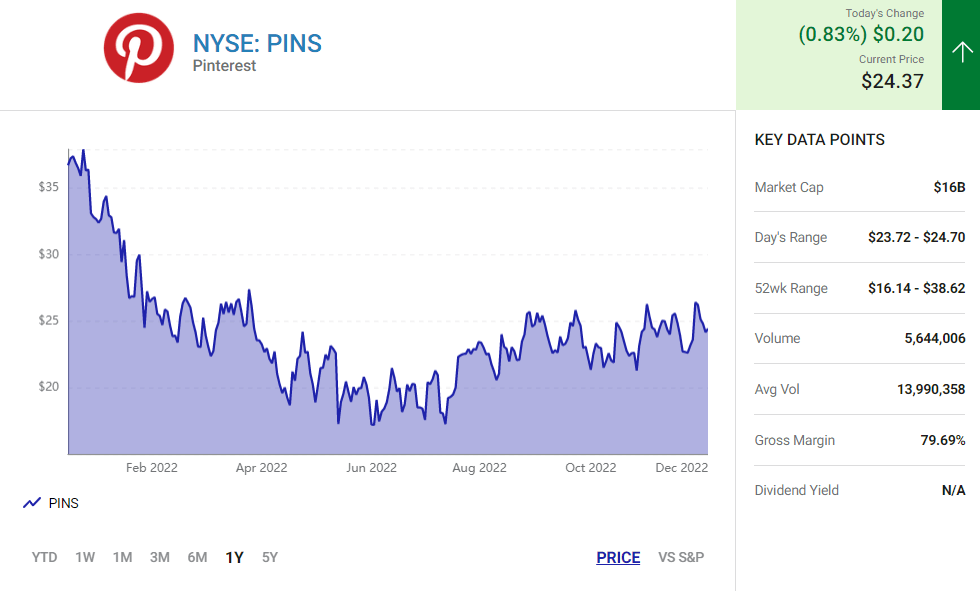
Like other social media stocks, Pinterest (PINS 0.83%) has fallen sharply over the last year as revenue growth has slowed, profits have fallen, and its user base has temporarily declined.

Those headwinds are the result of difficult comparisons with its performance in 2021, and a general slowdown in digital advertising that has weighed on peers like Alphabet, Meta Platforms, and Snap.

However, there are several reasons why Pinterest looks primed for a comeback. First, after several quarters of declines in its user base, the company returned to solid growth in the third quarter. Its user base grew in all three of its regions, up on a sequential basis from 433 million to 445 million.

Similarly, even in a challenging macro environment, Pinterest continues to grow average revenue per user (ARPU), which rose 11% overall to $1.56, and ARPU in North America, its most valuable market was up 15% to $6.13. That growth is a notable contrast from peers Meta and Snap, both of whom saw ARPU fall in the third quarter.

New CEO Bill Ready is also well versed in e-commerce, having previously run Google’s shopping and payments program, and Pinterest is fast making improvements in areas like video and ad performance tracking, making the platform more useful for users and advertisers.

Finally, Pinterest has an edge over other social media platforms because many of its users come to the site with purchase intent, making it more valuable to advertisers. The company is also solidly profitable on an adjusted basis. When the ad market bounces back, Pinterest is likely to be a big winner.

2. Okta: The leader in cloud identity

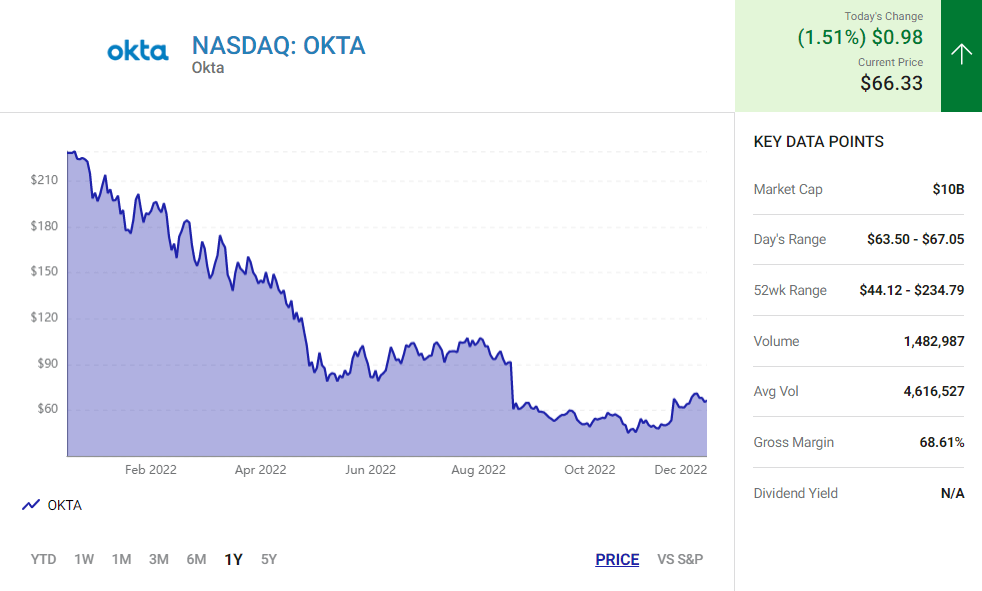
Okta (OKTA 1.51%) is another tech stock that has crumbled this year, but the sell-off represents a great buying opportunity for the independent leader in cloud identity software. Okta makes tools that allow businesses and employees to seamlessly and securely log in to the apps they need and stay connected.

It’s been a rich growth opportunity for the company thus far as revenue grew 37% in its most recent quarter, however, Okta is facing headwinds from the macroeconomic climate and unforced errors in its integration of Auth0, the customer identity software company it acquired last May.

While the company expects sales growth to decelerate, it’s also rapidly improved profitability, smashing estimates in the third quarter and showing Wall Street it has more control over its bottom line than previously thought.

Okta is also expanding its platform by going into adjacent markets like identity governance access and privileged access management, which make its addressable market now valued at $80 billion. That compares to expected revenue this year of less than $2 billion.

The software stock now trades at a price-to-sales ratio of 6, a great valuation for a company with a long growth path in front of it on the top line and rapidly improving margins on the bottom line.

3. The Trade Desk: An adtech pioneer

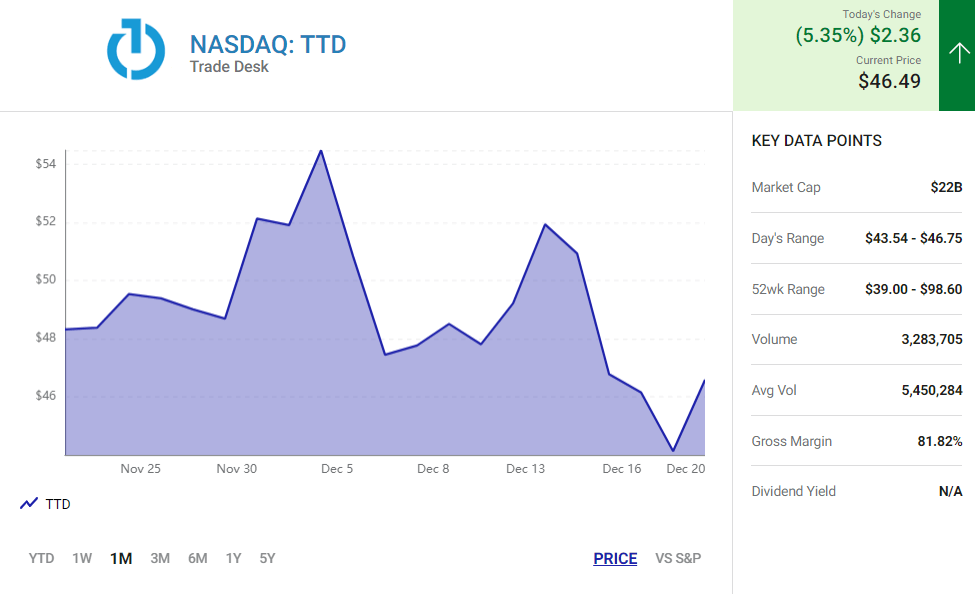
The Trade Desk (TTD 5.35%) is the most valuable pure-play ad tech company and a rare growth stock that also delivers strong profitability.

The Trade Desk operates a self-serve, cloud-based, demand-side platform, allowing customers to manage their ad campaigns in real time.

The product has been overwhelmingly popular as the company has had a customer retention rate of 95% or greater in every quarter over the last eight years, and has steadily grown over the last decade. Revenue was up 31% in the third quarter to $395 million, significantly outperforming its peers and digital ad platforms, and it posted an adjusted net income of $123 million, showing the scalability of its business model allows it to earn wide margins.

The Trade Desk’s Unified ID 2.0 is also shaping up to be the leading alternative to third-party cookies, which Google is planning to ban from Chrome by 2024. UID 2.0 is free, but it encourages customer loyalty and more sign-ups for its platform.

Despite The Trade Desk’s strong growth this year the stock is still down 50% due to headwinds in the ad industry. If the company can continue to grow through the potential recession, the stock is likely to explode when the economy rebounds and overall advertising demand bounces back.

Source: fool.com

Apple Christmas iPhone Sales Will Take Supply Chain Hit, Says JPMorgan; Cuts Price Target

Apple (AAPL) –  were active in pre-market trading Tuesday following a price target cut from analysts at JPMorgan and a muted holiday sales outlook.

JPMorgan analyst Samik Chatterjee clipped $10 from his Apple price target, taking it to $190 per share, while maintaining an ‘overweight’ rating on the stock heading into the final days of the trading year.

Chatterjee cautioned, however, that supply chain challenges, linked to the ongoing Covid disruption in China, would take some 4 million from the tech giant’s December iPhone sales, which he now pegs at around 70 million.

Last month, Bloomberg reported that Apple could see a 6 million shortfall in iPhone production from disruptions at its key China manufacturing plant, affecting mostly its high-end iPhone 14 Pro and Pro Max devices.

“We continue to see the supply shortfall continuing through year-end and impacting the typical seasonal uptick in iPhone volumes seen in Dec-Q. Thus, we are moderating our iPhone 14 Pro / Pro Max shipment forecast again in the Dec-Q,” Chatterjee said.

“We again expect the impact to estimates for FY23 overall to be more modest as we anticipate part of the shipment shortfall in the Dec-Q to be made up in the Mar-Q with supply constraints easing up in the lower production months and only a modest impact to demand given the historical precedent for Apple consumers to wait through a delay,” he added.

Apple shares were marked 0.17% higher in pre-market trading to indicate an opening bell price of $85.93 each.

Apple’s key China manufacturing hub, based in the north east city of Zhengzhou, saw violent protests in November as staff demonstrated against pay and working conditions in the 200,000-person plant run by Taiwan’s Foxconn.

Hundreds of workers were filmed in protest outside the plant, known as ‘iPhone City’, with some smashing windows and tearing down barricades, amid accusations of delayed bonus payments and dangerous working conditions linked to an earlier Covid outbreak.

The protests came shortly after Apple cautioned that Covid restrictions at the 200,000-person plant would curtail shipments of its higher-end iPhones heading into the holiday season in most of its global markets.

Apple CEO Tim Cook said in October that iPhone demand has remained healthy, but noted that supply constraints for both the 14 Pro and the 14 Pro Max continued to persist heading into the key holiday season, even prior to the added restrictions at Zhengzhou.

iPhone revenues, in fact, were an important component of Apple’s better-than-expected September quarter earnings, with sales rising 9.6% from last year to $42.62 billion.

Overall revenues, however, rose 2% from last year to an all-time high of $90.15 billion, helping Apple to a Street-beating fourth quarter earnings tally of $1.29 per share.

Source: thestreet.com