2022 was an unusual year for the stock market

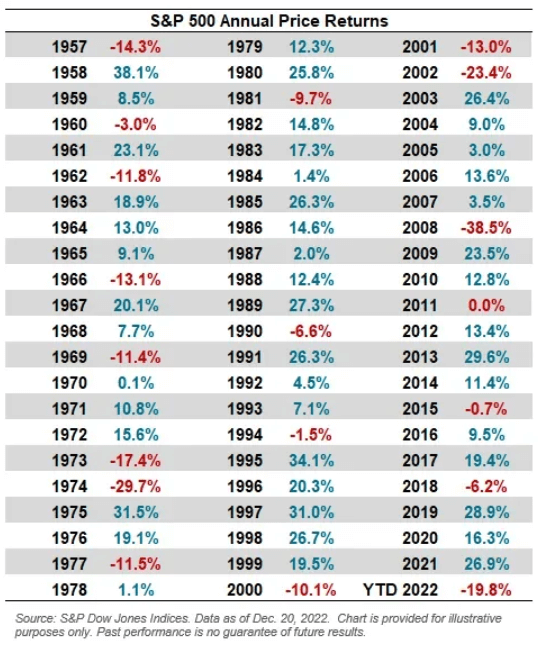
The S&P 500 closed Friday at 3,839.50, down 19.4% for the year. This makes 2022 the worst year for the S&P since 2008 and the fourth-worst year since the index’s launch 1957.
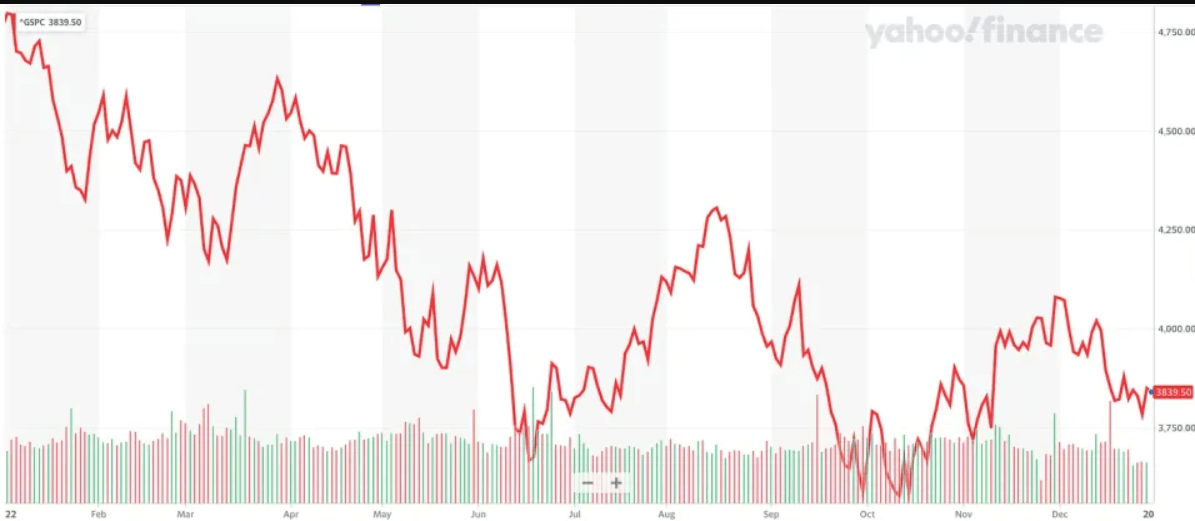
While it may be the case that the stock market usually goes up, 2022 was a reminder it doesn’t always go up. This is just part of the deal when it comes to successful long-term investing. The road to stock market riches comes with lots of ups and downs.

According to data compiled by Carson Group’s Ryan Detrick, the S&P 500 has had a positive year 71% of the time. It’s an incredible track record, but it isn’t perfect.
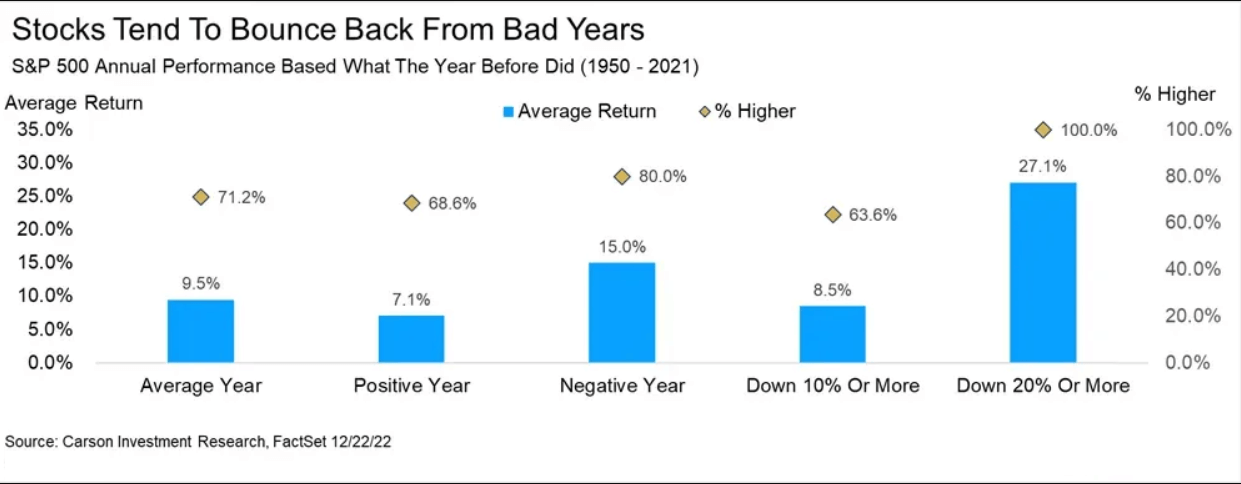
If history is a guide, then the odds favor positive returns in 2023. According to Detrick’s data, the S&P follows a negative year with a positive year 80% of the time with an average gain of 15%.

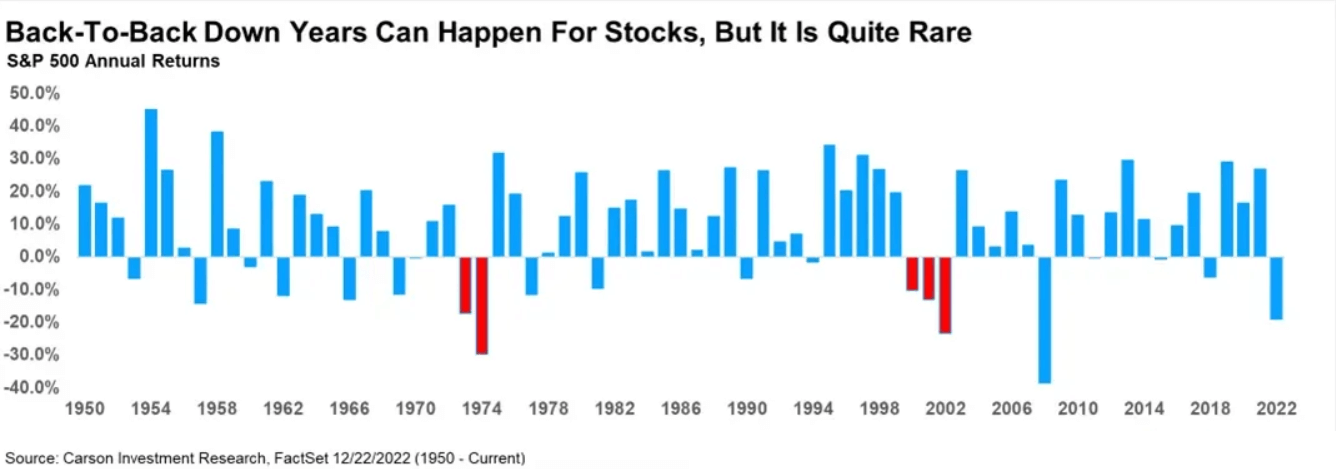
Again, the track record isn’t perfect. While it’s unusual for the S&P to see two consecutive years of negative returns, it’s not unprecedented. It happened after 1973 and 2000, and the subsequent year’s returns actually got worse.
TKer’s best insights about the stock market 📈

  • 10 truths about the stock market 📈The stock market can be an intimidating place: It’s real money on the line, there’s an overwhelming amount of information, and people have lost fortunes in it very quickly. But it’s also a place where thoughtful investors have long accumulated a lot of wealth. The primary difference between those two outlooks is related to misconceptions about the stock market that can lead people to make poor investment decisions.
  • Stomach-churning stock market sell-offs are normal🎢 Investors should always be mentally prepared for some big sell-offs in the stock market. It’s part of the deal when you invest in an asset class that is sensitive to the constant flow of good and bad news. Since 1950, the S&P 500 has seen an average annual max drawdown (i.e., the biggest intra-year sell-off) of 14%.
  • Wall Street’s 2023 outlook for stocks 🔭 I wouldn’t bet everything on a one-year prediction.Keep in mind that recent stock market performance won’t tell you what’ll happen in the coming months. Knowing where earnings are headed next year won’t necessarily tell you where stocks are headed. And while we’re on the subject of prices and earnings, the price/earnings ratio won’t tell you what’s coming next year, either. However, we do know that the stock market usually goes up in most years, and the long game is undefeated. And when you’re investing in stocks, time is a valuable edge.
  • How stocks performed when the yield curve inverted ⚠️ There’ve been lots of talk about the “yield curve inversion,” with media outlets playing up that this bond market phenomenon may be signaling a recession. Admittedly, yield curve inversions have a pretty good track record of being followed by recessions, and recessions usually come with significant market sell-offs. But experts also caution against concluding that inverted yield curves are bulletproof leading indicators.
  • How the stock market performed around recessions 📉📈 Every recession in history was different. And the range of stock performance around them varied greatly. There are two things worth noting. First, recessions have always been accompanied by a significant drawdown in stock prices. Second, the stock market bottomed and inflected upward long before recessions ended.
  • In the stock market, time pays ⏳ Since 1928, the S&P 500 generated a positive total return more than 89% of the time over all five-year periods. Those are pretty good odds. When you extend the timeframe to 20 years, you’ll see that there’s never been a period where the S&P 500 didn’t generate a positive return.
  • 700+ reasons why S&P 500 index investing isn’t very ‘passive’💡 Passive investing is a concept usually associated with buying and holding a fund that tracks an index. And no passive investment strategy has attracted as much attention as buying an S&P 500 index fund. However, the S&P 500 — an index of 500 of the largest U.S. companies — is anything but a static set of 500 stocks. From January 1995 through April 2022, 728 tickers have been added to the S&P 500, while 724 have been removed.
  • The key driver of stock prices: Earnings💰 For investors, anything you can ever learn about a company matters only if it also tells you something about earnings. That’s because long-term moves in a stock can ultimately be explained by the underlying company’s earnings, expectations for earnings, and uncertainty about those expectations for earnings. Over time, the relationship between stock prices and earnings have a very tight statistical relationship.
    When the Fed-sponsored market beatings could end 📈 At some point in the future, we’ll learn a new bull market in stocks has begun. Before we can get there, the Federal Reserve will likely have to take its foot off the neck of financial markets. If history is a guide, then the market should bottom weeks or months before we get that signal from the Fed.
  • What a strong dollar means for stocks👑 While a strong dollar may be great news for Americans vacationing abroad and U.S. businesses importing goods from overseas, it’s a headwind for multinational U.S.-based corporations doing business in non-U.S. markets.
  • Economy ≠ Stock Market 🤷‍♂️ The stock market sorta reflects the economy. But also, not really. The S&P 500 is more about the manufacture and sale of goods. U.S. GDP is more about providing services.
  • Stanley Druckenmiller’s No. 1 piece of advice for novice investors 🧐 …you don’t want to buy them when earnings are great, because what are they doing when their earnings are great? They go out and expand capacity. Three or four years later, there’s overcapacity and they’re losing money. What about when they’re losing money? Well, then they’ve stopped building capacity. So three or four years later, capacity will have shrunk and their profit margins will be way up. So, you always have to sort of imagine the world the way it’s going to be in 18 to 24 months as opposed to now. If you buy it now, you’re buying into every single fad every single moment. Whereas if you envision the future, you’re trying to imagine how that might be reflected differently in security prices.
  • Peter Lynch made a remarkably prescient market observation in 1994 🎯 Some event will come out of left field, and the market will go down, or the market will go up. Volatility will occur. Markets will continue to have these ups and downs. … Basic corporate profits have grown about 8% a year historically. So, corporate profits double about every nine years. The stock market ought to double about every nine years… The next 500 points, the next 600 points — I don’t know which way they’ll go… They’ll double again in eight or nine years after that. Because profits go up 8% a year, and stocks will follow. That’s all there is to it.
  • Warren Buffett’s ‘fourth law of motion’ 📉 Long ago, Sir Isaac Newton gave us three laws of motion, which were the work of genius. But Sir Isaac’s talents didn’t extend to investing: He lost a bundle in the South Sea Bubble, explaining later, “I can calculate the movement of the stars, but not the madness of men.” If he had not been traumatized by this loss, Sir Isaac might well have gone on to discover the Fourth Law of Motion: For investors as a whole, returns decrease as motion increases.
  • ‘Past performance is no guarantee of future results,’ charted 📊 S&P Dow Jones Indices found that funds beat their benchmark in a given year are rarely able to continue outperforming in subsequent years. According to their research, 29% of 791 large-cap equity funds that beat the S&P 500 in 2019. Of those funds, 75% beat the benchmark again in 2020. But only 9.1%, or 21 funds, were able to extend that outperformance streak into 2021.
  • One stat shows how hard it is to pick market-beating stocks 🎲 Picking stocks in an attempt to beat market averages is an incredibly challenging and sometimes money-losing effort. In fact, most professional stock pickers aren’t able to do this on a consistent basis. One of the reasons for this is that most stocks don’t deliver above-average returns. According to S&P Dow Jones Indices, only 22% of the stocks in the S&P 500 outperformed the index itself from 2000 to 2020. Over that period, the S&P 500 gained 322%, while the median stock rose by just 63%.

Data via S&P Dow Jones Indices:
Source: finance.yahoo.com
US Speeds Up Timeline in China Firms Delisting Threat

US lawmakers ratcheted up pressure on Chinese companies whose shares list on American stock exchanges to be more transparent with their financial audits.

Congress on Friday passed legislation to speed up the timeline for kicking companies off the New York Stock Exchange and Nasdaq if Washington regulators can’t fully review their audit work papers. After months of high-stakes drama, the tension eased last week when the Public Company Accounting Oversight Board said it gained sufficient access to audit documents from firms in China and Hong Kong for the first time.

Still, officials said they would continue to review the situation and could change their determination — a threat made more serious by the provision passed on Friday.

China and the US had been at odds over the issue for years, with Beijing citing national security concerns in opposition. The provision — included in a $1.7 trillion government funding package — speeds up the delisting process to two years from three and could affect roughly 200 companies from Hong Kong and China that trade on US exchanges.

“I’ve been fighting for more accountability for foreign companies that use American capital,” Senator John Kennedy, a Louisiana Republican who pushed for the change, said in a statement. Regulators are finally getting the power to “remind China that playing by the rules isn’t optional,” he added.

The White House said President Joe Biden would soon sign the legislation into law.

The long-simmering audit issue morphed into a political one as tensions swelled during the Trump administration. In 2020 Congress set out a three-year timetable for delisting shares for companies whose documents US watchdogs can’t review.

“Cranking up the pressure now will help us hold China’s feet to the fire and keep investors protected as we continue demanding complete access moving forward,” PCAOB Chair Erica Williams said in a statement.

Source: bloomberg.com

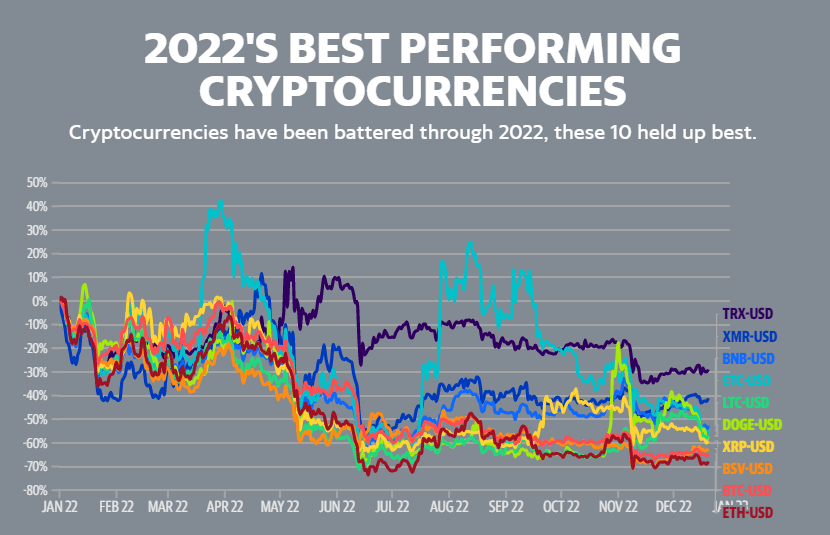
Crypto’s ‘best’ performers during 2022’s market washout

Crypto holders had a rough ride in 2022.

At the start of the year, the collective market cap of cryptocurrencies worldwide stood at $2.2 trillion. As the year ends, that figures stands at just below $800 billion.

The industry’s euphoric highs of last year descended into a bear market of epic proportions, leaving many of the industry’s major players in collapse. Or worse.

The plunge in crypto prices started with central banks cutting the cord on easy money policies, which dragged down risky assets first, and the problems multiplied from there — accounts were frozen, bankruptcies declared, frauds uncovered.

In 2021, cryptocurrencies powering Layer-1 tokens such as ethereum (ETH-USD), Avalanche (AVAX-USD), Solana (SOL-USD), Polygon (MATIC-USD), and Cosmos (ATOM-USD) stole the show.

This year that battle for outlandish returns whittled down to a competition for least bad losses. And the results are more of a grab bag of cryptocurrencies rather than reflecting a clear theme on the industry’s progress.

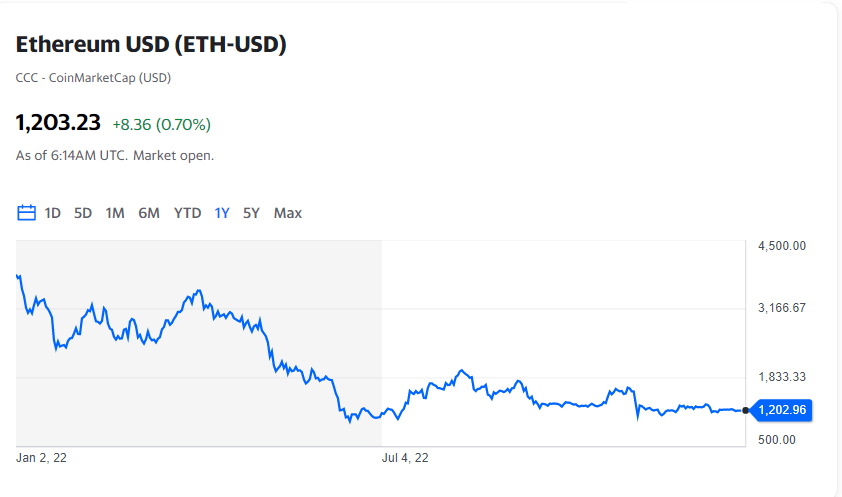
Ethereum (-68% YTD)

After outperforming bitcoin by 355% last year, ether (ETH-USD) came in as the 10th-best performing cryptocurrency in 2022, falling just less than 70% this year.

Despite its performance, the second-largest cryptocurrency pulled off the Merge upgrade in mid-September, transitioning to proof-of-stake from proof-of-work, which proved to be one of the industry’s few success stories in 2022.

The technological feat has also freed Ethereum core developers to dive into other initiatives meant to improve the protocol’s transaction scaling, privacy, and use as a financial layer.

Part decentralized banking layer and part tech platform, Ethereum still doesn’t offer the crucial feature of allowing investors to withdraw their staked deposits. As Galaxy Digital research associate Christine Kim has noted, Ethereum’s core developer team has said the protocol’s Shanghai upgrade, which will include staked ETH withdrawals, could be activated as early as March 2023.

The Merge made the Ethereum blockchain 99.95% more energy efficient and was a deflationary force on ether supply.

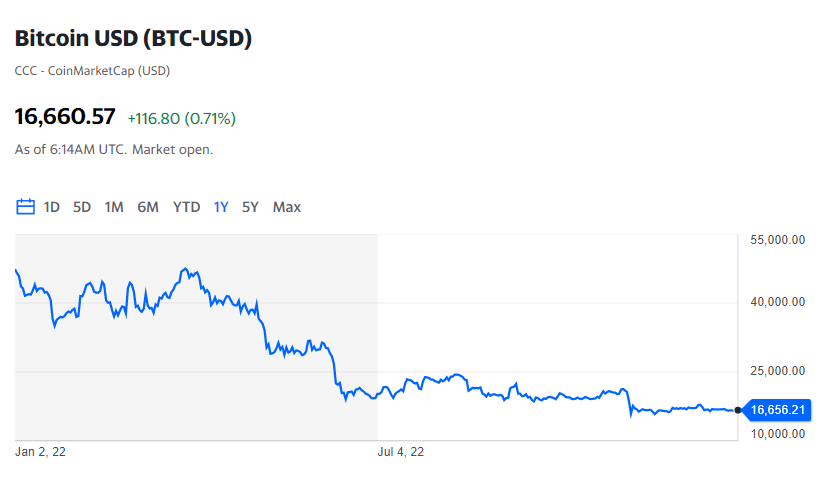
Bitcoin (-65% YTD)

The world’s biggest cryptocurrency fared better than some smaller counterparts, but was not immune from 2022’s market washout.

Bitcoin is down 76% from its November 2021 peak at $68,789 and currently trades near $16,500.

In April, when bitcoin traded at $41,000, Alex Thorn, head of research with Galaxy Digital, said he doesn’t think the market has changed its view on bitcoin (BTC-USD), which it sees as both “an option on a future where the cryptocurrency is treated like digital gold” and a “protest of the lack of credibility of central banking.”

Between its November 2021 peak and December 12, bitcoin investors have given back $213 billion in realized losses according to data collected by crypto analytics platform, Glassnode.

“In terms of an outlook for next year, it’s really hard to be bullish on bitcoin and crypto in general given the tenuousness of macro and monetary conditions,” Thorn added.

Dogecoin (-60% YTD)

Widely held by retail investors, the original “meme” coin followed most of the crypto market in a massive sell-off starting in the second quarter.

Still, Dogecoin fared better than many tokens in 2022.

However, unlike most major cryptocurrencies, Dogecoin (DOGE-USD) had already sold off from 64% from its May 2021 peak — reached when Elon Musk appeared on Saturday Night Live — to the end of 2021.

“People know that it’s a joke. They like the joke,” Thorn told.

Thorn’s team published a paper on DOGE at its 2021 peak, noting “a general lack of development effort,” and “no serious long-term narrative or use case.”

Still, Thorn’s team found Dogecoin “had a fair launch,” meaning it didn’t include a presale or venture capital fundraise, which can be red flags when insiders carry large stakes that put outside buyers at a disadvantage.

The cryptocurrency has outperformed most others through the fourth quarter, due in large part to Elon Musk’s deal to buy Twitter, with users speculating this purchase could have some benefits for Doge holders.

Ethereum Classic (-54% YTD)

Coming in with a 53% loss, Ethereum Classic (ETC-USD) also benefited from speculation leading up to the Merge.

While its use and developer community is a fraction of the size of Ethereum’s, Thomas Dunleavy, a senior market researcher for Messari, pointed out the small-cap token has routinely seen value appreciation ahead of Ethereum-related software upgrades.

As Ethereum’s Merge was reaching completion, skeptical investors viewed Ethereum Classic and other offshoots of the second largest cryptocurrency as a hedge or insurance policy in case the upgrade failed.

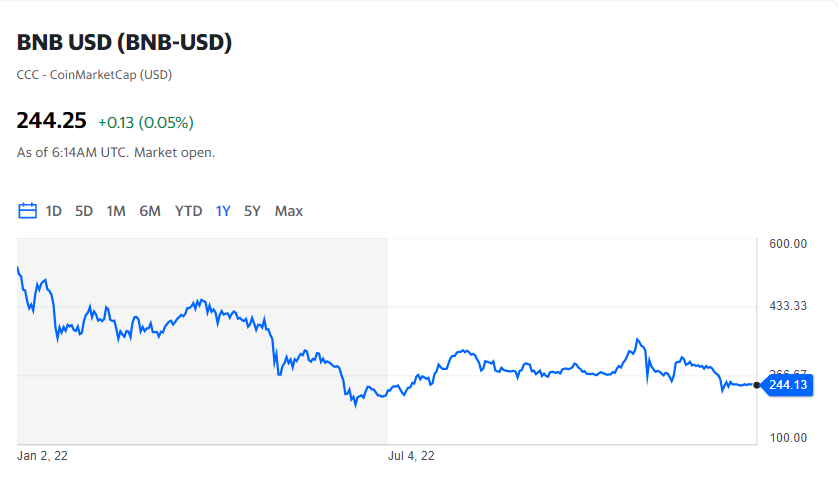
BNB (-53% YTD) and OKB (-17% YTD)

Exchange-associated tokens such as OKB (OKB-USD) and BNB (BNB-USD) both performed better than most cryptocurrencies this year.

BNB is the token associated with Binance, while OKB is the token for the OKX ecosystem.

However, as recent developments through the FTX crisis and the corresponding collapse in its exchange token FTT have shown, the value of these tokens can change quickly based on the management of their corresponding crypto exchange.

Exchange tokens can give holders specific benefits like lower trading fees and the ability to vote on exchange decisions. Exchange tokens are also almost always linked to a crypto exchange’s success as a business, serving in part like corporate equity.

Monero (-42% YTD)

As in past years, the tension between transparency and privacy for cryptocurrency transactions returned as an undercurrent through 2022.

Unlike Bitcoin and Ethereum, Monero (XMR-USD) gives users less censorable transaction privacy by default without requiring the use of crypto mixing services.

Monero’s more modest sell-off this year suggests its feature as a privacy coin offered users more utility than the majority of cryptocurrencies in the market.

Tron (-28% YTD)

TRX (TRX-USD), the native cryptocurrency of the Tron blockchain, came out ahead of most other cryptocurrencies, losing less than a third of its value this year.

The token’s value, according to Messari’s Thomas Dunleavy, has mainly benefited from the Tron ecosystem’s growing amount of stablecoin volume. TRX’s supply burn is based on its level of transaction volume.

As 2021 superstar LUNA imploded alongside its associated stablecoin TerraUSD (UST) in May, the Tron ecosystem launched its own decentralized stablecoin (USDD-USD). The Tron ecosystem’s network activity jumped 47% in the second quarter according to Messari.

Source: finance.yahoo.com

Global economy faces tougher year in 2023, IMF’s Georgieva warns

For much of the global economy, 2023 is going to be a tough year as the main engines of global growth – the United States, Europe and China – all experience weakening activity, the head of the International Monetary Fund said on Sunday.

The new year is going to be “tougher than the year we leave behind,” IMF Managing Director Kristalina Georgieva said on the CBS Sunday morning news program “Face the Nation.”

“Why? Because the three big economies – the U.S., EU and China – are all slowing down simultaneously,” she said.

In October, the IMF cut its outlook for global economic growth in 2023, reflecting the continuing drag from the war in Ukraine as well as inflation pressures and the high interest rates engineered by central banks like the U.S. Federal Reserve aimed at bringing those price pressures to heel.

Since then, China has scrapped its zero-COVID policy and embarked on a chaotic reopening of its economy, though consumers there remain wary as coronavirus cases surge. In his first public comments since the change in policy, President Xi Jinping on Saturday called in a New Year’s address for more effort and unity as China enters a “new phase.”

“For the first time in 40 years, China’s growth in 2022 is likely to be at or below global growth,” Georgieva said.

Moreover, a “bushfire” of expected COVID infections there in the months ahead are likely to further hit its economy this year and drag on both regional and global growth, said Georgieva, who traveled to China on IMF business late last month.

“I was in China last week, in a bubble in a city where there is zero COVID,” she said. “But that is not going to last once people start traveling.”

“For the next couple of months, it would be tough for China, and the impact on Chinese growth would be negative, the impact on the region will be negative, the impact on global growth will be negative,” she said.

In October’s forecast, the IMF pegged Chinese gross domestic product growth last year at 3.2% – on par with the fund’s global outlook for 2022. At that time, it also saw annual growth in China accelerating in 2023 to 4.4% while global activity slowed further.

Her comments, however, suggest another cut to both the China and global growth outlooks may be in the offing later this month when the IMF typically unveils updated forecasts during the World Economic Forum in Davos, Switzerland.

U.S. ECONOMY ‘MOST RESILIENT’

Meanwhile, Georgieva said, the U.S. economy is standing apart and may avoid the outright contraction that is likely to afflict as much as a third of the world’s economies.

The “U.S. is most resilient,” she said, and it “may avoid recession. We see the labor market remaining quite strong.”

But that fact on its own presents a risk because it may hamper the progress the Fed needs to make in bringing U.S. inflation back to its targeted level from the highest levels in four decades touched last year. Inflation showed signs of having passed its peak as 2022 ended, but by the Fed’s preferred measure, it remains nearly three times its 2% target.

“This is … a mixed blessing because if the labor market is very strong, the Fed may have to keep interest rates tighter for longer to bring inflation down,” Georgieva said.

Last year, in the most aggressive policy tightening since the early 1980s, the Fed lifted its benchmark policy rate from near zero in March to the current range of 4.25% to 4.50%, and Fed officials last month projected it will breach the 5% mark in 2023, a level not seen since 2007.

Indeed, the U.S. job market will be a central focus for Fed officials who would like to see demand for labor slacken to help undercut price pressures. The first week of the new year brings a raft of key data on the employment front, including Friday’s monthly nonfarm payrolls report, which is expected to show the U.S. economy minted another 200,000 jobs in December and the jobless rate remained at 3.7% – near the lowest since the 1960s.

Source: reuters.com

These 4 REITs May Be At Risk Of A Dividend Cut

Though the majority of publicly-traded real estate investment trusts (REITs) have been recovering over the past two months, the Federal Reserve’s hawkish stance combined with the macroeconomic uncertainties raise questions regarding their latest upswing.

Following the slightly hotter-than-expected inflation data released earlier this month, the Federal Reserve will likely keep up its aggressive rate hikes in 2023, which might wipe out recent gains. This comes as Fed Chair Jerome Powell stated in the last Federal Open Market Committee meeting, “It will take substantially more evidence to have confidence that inflation is on a sustained downward path.”

Given the increasing borrowing costs, the profit margins of many REITs are expected to shrink further, resulting in potential dividend cuts.

SL Green Realty

SL Green Realty Corp. (NYSE: SLG) is New York City’s largest office landlord, owning and operating 33.6 million square feet across 62 commercial buildings. The office REIT currently pays $3.25 in dividends annually — divided into equal monthly installments — yielding 9.6% on the current price.

But don’t be tempted by the impressive dividend yield. SL Green Realty has been pummeled by the declining demand and occupancy of office properties amid the rising popularity of remote work culture. The REIT reduced its dividend per share by 12.9% to $0.3108 for December, as it expects its operating cash flows and funds available for distribution to decline next year.

SL Green Realty stock was also recently downgraded by BMO Capital Markets analyst John Kim as well as Scotiabank analyst Nicholas Yulico. After the office REIT slashed its monthly dividend on Dec. 5, Kim downgraded the stock to Market Perform from Outperform, while Yulico downgraded it to Sector Underperform.

Many analysts expect the company’s loss margins to widen next year as the rising interest rates tighten spreads. SL Green Realty might incorporate further dividend cuts next year.

Douglas Emmett

Douglas Emmett Inc. (NYSE: DEI) is a residential REIT that owns and operates more than 4,600 apartment units in Los Angeles and Honolulu. It also has ownership interests in office spaces in the submarket regions of the two cities.

The REIT pays $0.76 in dividends annually, translating to a 4.75% yield. It slashed its dividend payouts by over 32% quarter over quarter from $0.28 to $0.19 per share for the fiscal fourth quarter.

With Douglas Emmett’s growth prospects over the next year being bleak at best as the Fed maintains its hawkish stance, several dividend cuts could be on the horizon. Shares of Douglas Emmett hit 52-week lows on Dec. 7.

AGNC Investment

AGNC Investment Corp. (NASDAQ: AGNC) is one of the most prominent agency-backed mortgage REITs (mREITs) in the U.S. Unsurprisingly, the REIT has been hard hit by the rate hikes, as its shares fell by nearly 30% year to date.

AGNC Investment’s latest financials reflect a substantial downturn, as the market headwinds linger.

“Broad-based weakness in the financial markets, and fixed income markets in particular, continued in the third quarter of 2022 as global macroeconomic and monetary policy uncertainty intensified,” AGNC Investment President and CEO Peter Federico said. “This dynamic contributed to the underperformance of agency MBS [mortgage-backed securities] in the third quarter.”

In the fiscal third quarter that ended Sept. 30, the REIT’s tangible book value per share stood at $9.08, a 20.6% decline from the prior quarter. Its comprehensive net loss amounted to $2.01 per share, while economic return came in at negative 17.4%.

Though AGNC’s bottom line is expected to improve in this quarter, the number is expected to be significantly lower compared to the fiscal fourth quarter of 2021. The REIT might slash its dividend payouts in the upcoming months as its profit margins dwindle. It currently pays $1.44 in dividends annually, yielding 13.47%. AGNC Investment has a poor payout history, as its dividend payouts have declined at a 10.7% compound annual growth rate (CAGR) over the past three years.

Office Income Properties

Office Properties Income Trust (NASDAQ: OPI) owns and leases commercial office properties primarily to investment-grade rated single tenants. The commercial REIT pays $2.20 in dividends annually, yielding an impressive 15.9% on the current stock price.

But the high dividend yield percentage might be a yield trap, given its unfavorable financials. Over the past five years, the REIT’s dividend payouts have declined at a 20.4% CAGR. Shares of Office Income Properties have plunged by over 44% over the past year. Office Income Properties Trust’s total shareholder returns over the past five years stood at negative 69%.

The consensus revenue estimate of $139.17 million for the fiscal fourth quarter ending Dec.

31 indicates a 5.5% year-over-year decline. Analysts expect the REIT’s adjusted funds from operations to be negative, which might result in dividend cuts down the line.

Source: finance.yahoo.com

Amazon stock ‘at a good price point’ if investors can wait out rocky 2023

If can you look past what is likely to be a challenging start to 2023 for Amazon (AMZN), the bruised stock is a buy, says EvercoreISI’s Mark Mahaney.

“I think the core thesis on Amazon is well intact,” Mahaney said. “It’s just that it’s fully exposed to all the consumer softening trends, especially in discretionary items, and inflationary pressure. It’s going to take time for the Amazon ship to right itself, but it will right itself. I think depending on how long-term your horizon is, if you are willing to look out more than a year, I think Amazon’s at a good price point here.”

Right now, that is a tall order to ask most investors given how tough Amazon’s year has been financially and from a stock price perspective.

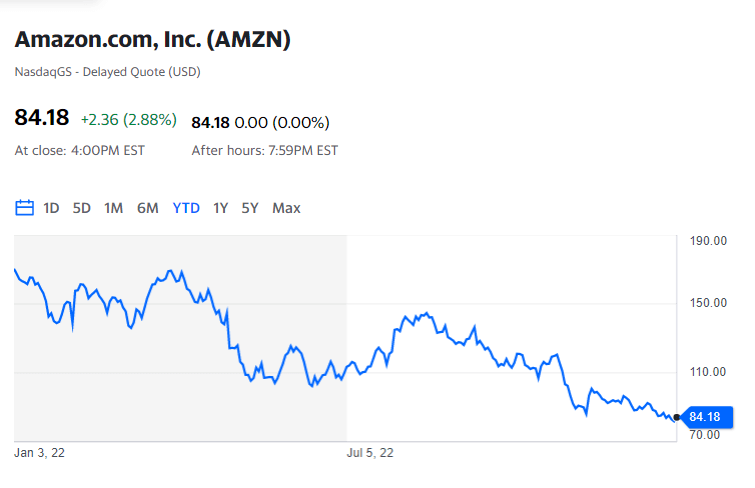
Shares of the tech giant are now hovering at a fresh 52-week low and are down about 50% year to date. The stock is off by 13% in December alone.

That performance rivals the dreadful performances from Amazon’s counterparts in the closely followed FAANG (Facebook/Meta, Apple, Amazon, Netflix, Google) complex, with Meta enduring a 64% drop and Netflix plunging 51% year to date.

As for its fundamentals, Amazon announced on Oct. 27 it missed third-quarter analyst estimates as top-line growth continued to cool and costs remained elevated. For the fourth quarter, Amazon guided that revenue would come in between $140 billion and $144 billion instead of the $155 billion then projected by analysts.

Amazon shares were hammered by nearly 10% the following day.

A few weeks after the lackluster quarter and outlook, Amazon reportedly began laying off around 10,000 workers in an effort to get its cost structure under control.

EvercoreISI’s Mahaney conceded that Amazon must go further on cost cuts if the stock is to work higher in 2023.

“Amazon is going to have some issues,” he said. “They need to get a little bit more aggressive on costs.”

Source: finance.yahoo.com

Apple Stock at 52-Week Lows: Here’s the Trade

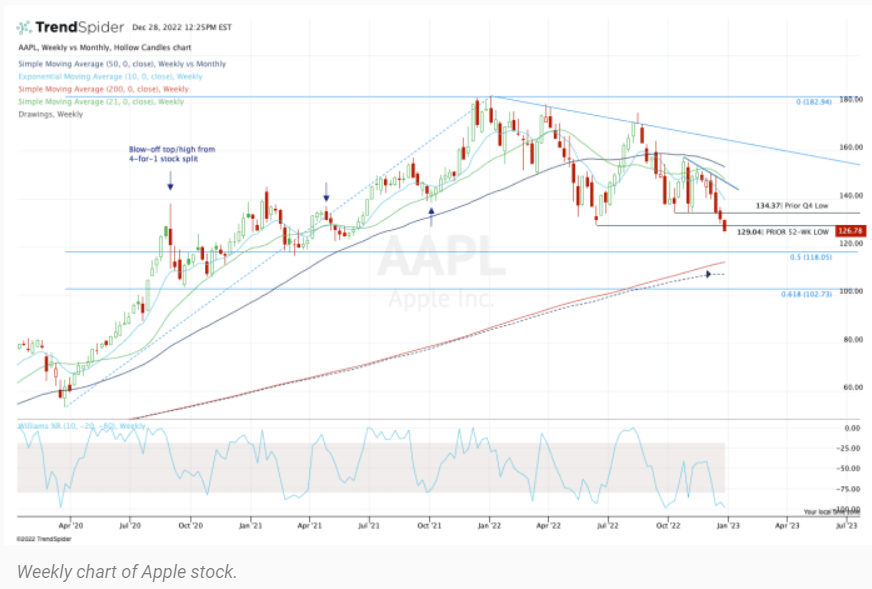
Apple stock is making 52-week lows for a second session. Here are the levels to know right now.

This is not too surprising, as the tech giant broke below a key support level earlier this month. And on Wednesday Apple shares fell 2.6%, touching 52-week lows for a second session.

If the stock closes lower today, it will mark Apple’s ninth decline in the past 10 sessions.

Despite its robust financials, investors earlier this month may have had a problem paying roughly 25 times earnings for flat earnings and revenue growth this year.

IPhone reports also raise a bit of concern amid Apple’s busiest quarter, while unrelenting selling pressure in tech is bound to weigh on the largest company in the U.S.

While Apple has held up the best among FAANG stocks when measured from the one-year highs, Apple stock has performed the worst in the group over the past month, down over 14%.

Trading Apple Stock

Over the past 12 years, Apple stock has suffered several notable corrections. From peak to trough, the losses have weighed in at 35%, 39%, 33.5% and 45.4%.

Just going by the figures above, we could say a 35% to 40% correction is not unheard of for Apple. Its current peak-to-trough decline in this rout is 30.9%.

While Apple could bottom today and rally throughout 2023, history says that it wouldn’t be unusual to see a further decline. When we pair it with the charts, a few levels jump out.

First, the $118 to $120 zone stands out, with the latter being a key pivot in 2020 and in early 2021. With the 50% retracement from the all-time high down to the covid low coming into play at $118, this would be a logical area for some long-term investors to consider adding some exposure.

In that range, the shares would be down 35% from the high.

Other investors may consider waiting for a test of the 200-week moving average, which is currently rising, but near $114.

Now, this measure is notable since it’s been major support in every one of the corrections listed above, except for the covid correction (as Apple stock did not dip far enough to test this measure).

If Apple tests this level, long-term investors may truly want to consider adding some exposure, given the dependability of this moving average.

Keep in mind that Apple stock may truly not fall this far — and that’s a scenario buyers must watch out for. They also must be prepared for the possibility that the $114 to $120 area doesn’t act as support, either.

If the selling becomes an avalanche, the 61.8% retracement and $100 to $105 area is a possibility. For what it’s worth, Apple would be down about 44% from its highs at that point.

Keep these levels in mind if you’re stalking a long position in Apple stock.

Source: finance.yahoo.com

5 Companies With Huge Free Cash Flow

Many investors try to identify companies that they believe will be around for the long haul before making significant investments. They hope that, if the stock of any of these companies takes a nosedive, it will only be a matter of time before it rebounds.

One way to identify a company with these characteristics is to look for companies with major free cash flow (FCF). FCF is the cash flow that is available to a company; it can be used to repay creditors or pay dividends and interest to investors. Some investors prefer to pay attention to this aspect of a company’s financials, rather than earnings or earnings per share, as a measure of its profitability.

KEY TAKEAWAYS

  • One way to identify a company that is likely to rebound in the long-run–even if its stock takes a nosedive–is to look for companies with major free cash flow (FCF).
  • Free cash flow (FCF) is the cash flow that is available to a company; free cash flow can be used to repay creditors or pay dividends and interest to investors.
  • Some investors prefer to pay attention to this aspect of a company’s financials, rather than earnings or earnings per share, as a measure of its profitability because unlike revenue or earnings, cash flow figures cannot be manipulated.

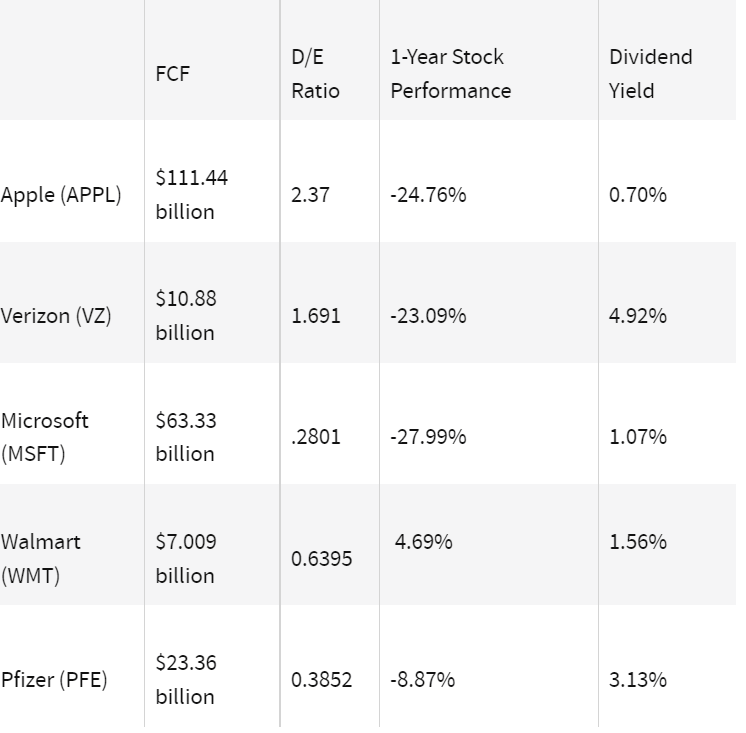
Apple (APPL), Verizon (VZ), Microsoft (MFST), Walmart (WMT), and Pfizer (PFE) are five companies that could be considered free cash flow (FCF) “monsters” as a result of their history of having a huge amount of free cash flow (FCF).

Why Is Free Cash Flow Important?

Revenue and earnings are both imperative metrics, but both can be manipulated. For example, retailers can manipulate revenue by opening more stores. Earnings numbers can be skewed by corporate buybacks, which reduces the share count and, ultimately, improves earnings per share (EPS).

Investors should never overlook the figures that indicate a company’s FCF because, unlike revenue and earnings, cash flow can never be manipulated. In addition, a company with a good amount of free cash flow may also be more likely to make dividend payments, and engage in buybacks, acquisitions for inorganic growth, and innovation for organic growth. Not to mention that free cash flow also provides opportunities for debt reduction.

The bigger the FCF figure is, the more maneuverability the corporation is going to have. This can allow for positive growth during economic booms and flexibility during an economic downturn, regardless of if those bad times are related to the broader market, the industry, or the company itself.

All five of these companies with major FCF are also household names. This factor can play a big role in a company’s staying power because of the level of consumer trust these brands have garnered.

While FCF is an important metric, it’s still only one of many metrics. It’s also important to consider if a company has been growing its top line and is consistently profitable, as well as the company’s debt-to-equity ratio, one-year stock performance, and dividend yield.

5 Companies With Major Free Cash Flow

Here are five examples of companies that have historically shown large free cash flow figures. These statistics represent data as of Dec. 27, 2022:

All five of these companies have been consistently profitable, although not all of them have delivered consistent revenue growth in the same time frame. A high debt-to-equity ratio is usually a negative sign, but when a company has a strong cash flow generation, it can minimize the debt risk.

The Bottom Line

The five free cash flow monsters above should be considered for further research, but only if you’re a long-term investor. There are many questions in markets about the global economy right now and no stock is invincible. However, if history continues to repeat itself, then the five stocks above should be safer than most.

Source: investopedia.com

Active investing poised to be on the rise in 2023

As 2022 nears a wrap, a trend is emerging that’s expected to gain traction next year — actively managed investment strategies — along with a custom strategy for people who like the idea of investing in a basket of companies, but want more control of what they invest in.

Assets in direct indexing are expected to climb to $825 billion by 2026, from roughly $462 billion now, according to Cerulli Associates, a global research and consulting firm, based in Boston, Mass. That tops growth forecasts for exchange-traded funds, mutual funds and separately managed accounts.

Here’s what’s behind the developing shift: Many analysts foresee loads of volatility for stocks in 2023, particularly early in the year, and an overall flat return scenario for the entire year, given the combo of still-high inflation, Fed rate hikes, and a potential recession. And some folks want more control.

“It’s part of a much broader trend towards personalized portfolios,” told Tom O’Shea, director at Cerulli.

Direct-indexing enters the mainstream

Direct indexing lets investors cherry-pick which stocks to buy in a benchmark index instead of owning a fund that tracks a specific gauge like the S&P 500.

A hands-on approach allows for you to adjust for changing market conditions in a turn-on-the-dime manner, something that is not in the cards for investors in passively managed retirement portfolios that mimic the ups and downs of whichever index is being tracked.

“Direct indexing allows investors to buy the individual stocks in an index directly as opposed to owning a predetermined selection of stocks through a fund,” told Marguerita Cheng, a Certified Financial Planner and CEO at Blue Ocean Global Wealth, in Gaithersburg, Md. “Investors can customize their holdings to align with their risk tolerance and investment preferences.”

“But there are some cons,” Cheng added. “Direct indexing, for example, can be more expensive than passive investing and may cause clients to lose focus of their long-term financial goals and encourage more frequent trading.”

Plain vanilla index funds vs DIY

Investing in Steady Eddie index funds — balanced across stocks, such as the S&P 500 index, and fixed-income bond funds put on auto-pilot for months on end — has been standard advice for many individuals, particularly those socking away retirement funds.

The overarching idea is that it’s simpler and less expensive to buy an entire index that is computer-generated than it is to try to select individual stocks to buy and sell. And, generally speaking, you have a better chance of shaking off the slumps in the stock market if you simply stay the course. Moreover, trying to find the perfect time to invest is tricky and almost always a huge mistake.

For scores of retirement savers, however, that passive strategy has been hard to stomach this year as markets have been pummelled. With inflation not yet under control and the overall stock market still teetering–the S&P 500 index has fallen around 19% so far this year, it’s hard to fight back the urge to step in and tweak your accounts, especially if you’re nearing retirement.

“Firms that cater to do-it-yourself investors like Schwab, Vanguard, and Fidelity are rolling out these personalized products and what we’re seeing is there’s a lot of investors who like to own individual securities for a variety of reasons,” O’Shea said.

“The tax benefits are one reason these have appeal,” he said. “They’re not necessarily buying into a mutual fund that has embedded capital gains, for example. They’ll be able to customize their portfolio according to their taxes. And then other characteristics that they might find important. It could be risk, maybe a low volatility portfolio. It could also be ESG, which is increasingly becoming important, particularly to young people.”

A custom solution

This year, Fidelity, for example, launched customized index funds for do-it-yourself brokerage customers. To create a custom index, you pick a group of stocks that you want to invest in based on whatever theme you choose — say, clean energy stocks — then determine the percentage weighting of each investment and invest all those stocks in a single basket.

After a free trial, the service costs $4.99 per month. The custom baskets can be used in non-retirement brokerage accounts, including Health Savings Accounts (HSAs) as well as Traditional IRAs, Roth IRAs, and rollover IRAs. You can invest in up to 50 stocks and create as many baskets as you want.

“We knew investors wanted more than just basket trading; they want a simplified way to monitor and trade their customized portfolios with just one click, and trade securities using Fidelity’s real-time fractional shares engine,” Josh Krugman, senior vice president of brokerage at Fidelity, told Yahoo Money. “This new ability to invest in and customize portfolios built from Fidelity’s thematic models puts direct indexing capabilities into the hands of DIY retail investors.”

Yet, recent Cerulli surveys show that only 14% of financial advisors are aware of, and recommend, direct indexing solutions to clients. For now, these hands-on offerings are still a small slice of the overall mutual fund sandbox.

“For tax-deferred or tax-free retirement accounts, more control over taxes may not be as compelling as rebalancing can occur without incurring tax consequences,” Cheng said. “For taxable accounts, flexibility and control with regards to taxes and security selection can be beneficial depending on the client’s personal and financial circumstances.”

The case for a blended strategy

Passive investing, however, isn’t fading away, by any measure.

In 2021, passively managed index funds for the first time accounted for a greater share of the U.S. stock market than actively managed funds’ ownership, according to the Investment Company Institute’s 2022 Factbook. Passive funds accounted for 16% of the U.S. stock market at the end of 2021, compared with 14% held by active funds. A decade ago, active funds held 20% and passive ones, 8%.

“I don’t buy this idea of the end of passive investing for a minute,” told Daniel Wiener, chairman of Adviser Investments, in Newton, Mass. “I have not heard or read of a single person of any substance saying that the end of passive investing is nigh.”

Importantly, fees are low for pre-set index baskets of stocks and bonds.

In 2021, the average expense ratio of actively managed equity mutual funds was 0.68%, compared with average index equity mutual fund expense ratio of 0.06%, according to a report by the Investment Company Institute. Active management ETFs have an average expense ratio of 0.69%.

The passive approach of set and forget makes perfect sense, particularly if you’re investing for the long haul and aren’t hardwired to be a stock jockey. The batting averages also support passive investing.

Over the past 15 years, more than 70% of actively managed funds failed to outperform their comparison index in 38 of 39 categories, according to the S&P Dow Jones Indices (SPIVA) mid-year 2022 survey on the performance of active mutual fund managers.

Moreover, the S&P 500 has increased on average by 29% in the three years following a 20% plus decline dating back to 1950, according to data analysis by Truist chief market strategist Keith Lerner.

“It doesn’t hold water – if expectations are that returns will be lower in the years ahead then both passive and active funds with low expense ratios should be the preferred investment vehicles,” Wiener said. “So, T. Rowe Price, Vanguard, and Fidelity funds with low operating expenses, as well as low expense ratio ETFs, will remain the preferred investments.”

Source: finance.yahoo.com

10 Biggest Car Companies

TM, VWAGY, and STLA lead the 10 biggest car companies list…

The automotive industry is a crucial part of the global economy, producing vehicles that efficiently transport people and goods within nations and across entire regions. These companies manufacture cars, trucks, vans, and sport utility vehicles (SUVs). Some even produce motorcycles, all-terrain vehicles, and commercial vehicles like transport trucks and buses.

The biggest auto manufacturers have a large global footprint, selling vehicles to consumers and businesses worldwide. These big companies are mainly headquartered in just a few countries that lead the industry; however, the list of the 10 biggest also includes car companies from other countries.

We look in detail below at the 10 biggest car companies by trailing 12 months (TTM) revenue as of December 21, 2022. Some companies outside the U.S. report profits semi-annually instead of quarterly, so the TTM data may be older than it is for companies that report quarterly. This list is limited to publicly traded companies in the U.S. or Canada, either directly or through ADRs.

Important: Some of the stocks below are only traded over-the-counter (OTC) in the U.S., not on exchanges. This may be because they are foreign companies that do not have sponsored ADRs on traditional exchanges. As a result, trading OTC stocks often carry higher trading costs than trading stocks on exchanges. Additionally these stocks may be subject to foreign exchange fluctuations. This can lower or even outweigh potential returns.

#1 Volkswagen AG (VWAGY)

  • Revenue (TTM): $284.34 billion
  • Net Income (TTM): $19.76 billion
  • Market Cap: $81.0 billion
  • 1 Year Return (TTM): -36.5%
  • Exchange: OTC

Volkswagen is a Germany-based multinational automotive manufacturing company. It develops and produces passenger cars, trucks, and light commercial vehicles such as buses. Vehicle models include the Tiguan, Golf, Jetta, Passat, and more. The company stopped making its once-popular Volkswagen Beetle compact car last year due to falling demand for smaller cars. Volkswagen’s best-known luxury brands are Porsche and Audi. The company also manufactures parts and offers customer financing and fleet management services.

#2 Toyota Motor Corp. (TM)

  • Revenue (TTM): $270.58 billion
  • Net Income (TTM): $20.39 billion
  • Market Cap: $189.4 billion
  • 1 Year Return (TTM): -21.8%
  • Exchange: New York Stock Exchange (NYSE)

Toyota is a Japan-based multinational. It was the first foreign manufacturer to build a dominant market share in the U.S. automobile market by setting the industry standard for efficiency and quality. Toyota designs and manufactures cars, trucks, minivans, and commercial vehicles. Vehicle models include the Corolla, Camry, 4Runner, Tacoma, and the Prius, the hybrid electric sedan. Lexus is the company’s luxury car division. Toyota also produces parts and accessories and provides dealers and customers with financing.

#3 Stellantis (STLA)

  • Revenue (TTM): $181.58 billion
  • Net Income (TTM): $16.97 billion
  • Market Cap: $45.2 billion
  • 1 Year Return (TTM): -15.8%
  • Exchange: NASDAQ

Stellantis is a multinational automaker that was created in 2021 through the merger of French automaker Groupe PSA and Italian-American automaker FCA (Fiat Chrysler Automobiles). The company is one of the largest automakers in the world, with a strong presence in Europe, North America, and South America. Stellantis offers a wide range of vehicles, including passenger cars, trucks, vans, and SUVs, under various brands including Peugeot, Citroën, DS, Opel, Vauxhall, Jeep, Ram, Dodge, and Chrysler. The company is headquartered in Amsterdam, Netherlands.

#4 Mercedes Benz AG (MBGYY)

  • Revenue (TTM): $156.23 billion
  • Net Income (TTM): $25.64 billion
  • Market Cap: $70.2 billion
  • 1 Year Return (TTM): -6.0%
  • Exchange: OTC

Mercedes Benz is a Germany-based multinational automobile manufacturer. The company manufactures passenger cars, vans, off-road vehicles, and commercial vehicles like transport trucks and buses. It produces vehicles under several brands, including Daimler, Mercedes-Benz, FUSO, Western Star, and more. Mercedez Benz also offers financing and leasing packages for customers and dealers.

#5 Ford Motor Co. (F)

  • Revenue (TTM): $151.74 billion
  • Net Income (TTM): $9.01 billion
  • Market Cap: $46.1 billion
  • 1 Year Return (TTM): -39.0%
  • Exchange: NYSE

Ford is a multinational automotive manufacturer based in Michigan. The company develops, manufactures, and services cars, SUVs, vans, and trucks. Vehicle models include the Fusion, Mustang, Edge, Escape, F-150, Ranger, and more. The company also provides vehicle-related financing and leasing.

#6 General Motors (GM)

  • Revenue (TTM): $147.21 billion
  • Net Income (TTM): $9.68 billion
  • Market Cap: $50.0 billion
  • 1 Year Return (TTM): -34.6%
  • Exchange: NYSE

General Motors (GM) is a multinational automobile manufacturer. The company designs and manufactures cars, trucks, and automobile parts. It has been a leader in the development of electric cars, first with the Chevy Volt and its successor, the Chevy Bolt. It operates under four major vehicle brands: GMC, Chevrolet, Cadillac, and Buick. The company also offers automotive financing.

#7 Honda Motor Co. Ltd. (HMC)

  • Revenue (TTM): $126.17 billion
  • Net Income (TTM): $5.29 billion
  • Market Cap: $39.8 billion
  • 1 Year Return (TTM): -11.1%
  • Exchange: NYSE

Honda is a Japan-based multinational automobile company. It manufactures passenger cars, trucks, vans, all-terrain vehicles, motorcycles, and related parts. Vehicle models include the Civic, Accord, Insight Hybrid, Passport, Odyssey, Fit and more. Acura is the company’s luxury car division. The company also provides financial and insurance services.

#8 Tesla Motors (TSLA)

  • Revenue (TTM): $74.86 billion
  • Net Income (TTM): $11.19 billion
  • Market Cap: $435.0 billion
  • 1 Year Return (TTM): -54.1%
  • Exchange: NASDAQ

Tesla is a manufacturer of electric vehicles and clean energy solutions. Tesla manufactures four electric models, the Model 3, Model Y, Model S, and Model X. Each model is capable of speeds of more than 135 miles per hour and can accelerate from 0-60 in less than 4.8 seconds. They all have a range of more than 320 miles and generate more than 346 horsepower. Tesla provides financing for retail customers.

#9 Nissan Motors (NSANY)

  • Revenue (TTM): $73.73 billion
  • Net Income (TTM): $0.9 billion
  • Market Cap: $12.7 billion
  • 1 Year Return (TTM): -33.4%
  • Exchange: OTC

Nissan is a Japan-based multinational automotive company. It designs and manufactures passenger vehicles, forklifts, marine equipment, and related parts. Vehicle models include the Altima, Maxima, Sentra, Versa, Pathfinder, Rogue, Titan, and its LEAF electric car. The company’s luxury division is Infiniti. The company also offers financing and leasing services.

#10 BYD Co. Ltd. (BYDDY)

  • Revenue (TTM): $51.37 billion
  • Net Income (TTM): $1.48 billion
  • Market Cap: $74.7 billion
  • 1 Year Return (TTM): -18.0%
  • Exchange: OTC

BYD Co. Ltd. is a Chinese multinational corporation that specializes in the design, development, and manufacture of a wide range of products, including electric vehicles, batteries, solar panels, and other renewable energy products. The company is headquartered in Shenzhen, China and has operations in more than 50 countries around the world. BYD is known for its leadership in the electric vehicle industry and has a strong presence in both the passenger car and commercial vehicle markets. In addition to its core businesses, BYD also has a significant presence in the renewable energy sector and is a leading supplier of solar panels and energy storage systems.

Source: investopedia.com