Taxes: Here are the federal tax brackets for 2023 vs. 2022

The income thresholds for the seven federal tax brackets increased by a bigger-than-normal amount for the 2023 tax year to reflect runaway inflation seen last year.

“They are just the usual changes due to inflation,” Jon Whiten, from the Institute on Taxation and Economic Policy told Yahoo Finance. “More dramatic this year since inflation was also dramatic.”

The inflation-adjusted amounts jumped by more than 7% from 2022, according to the Tax Policy Center, compared with last year’s 3% uptick. The changes themselves are not a new development — the Internal Revenue Service adjusts its tax brackets annually for inflation.

One positive outcome: Taxpayers whose income didn’t rise on par with inflation last year will likely avoid tax bracket creep in 2023 and ultimately pay lower taxes.

Changes to 2023 federal income tax brackets

For the 2023 tax year, there are seven federal tax brackets: 10%, 12%, 22%, 24%, 32%, 35%, and 37%. Your tax bracket is determined by your taxable income and filing status and shows what tax rate you’ll pay on each portion of your income.

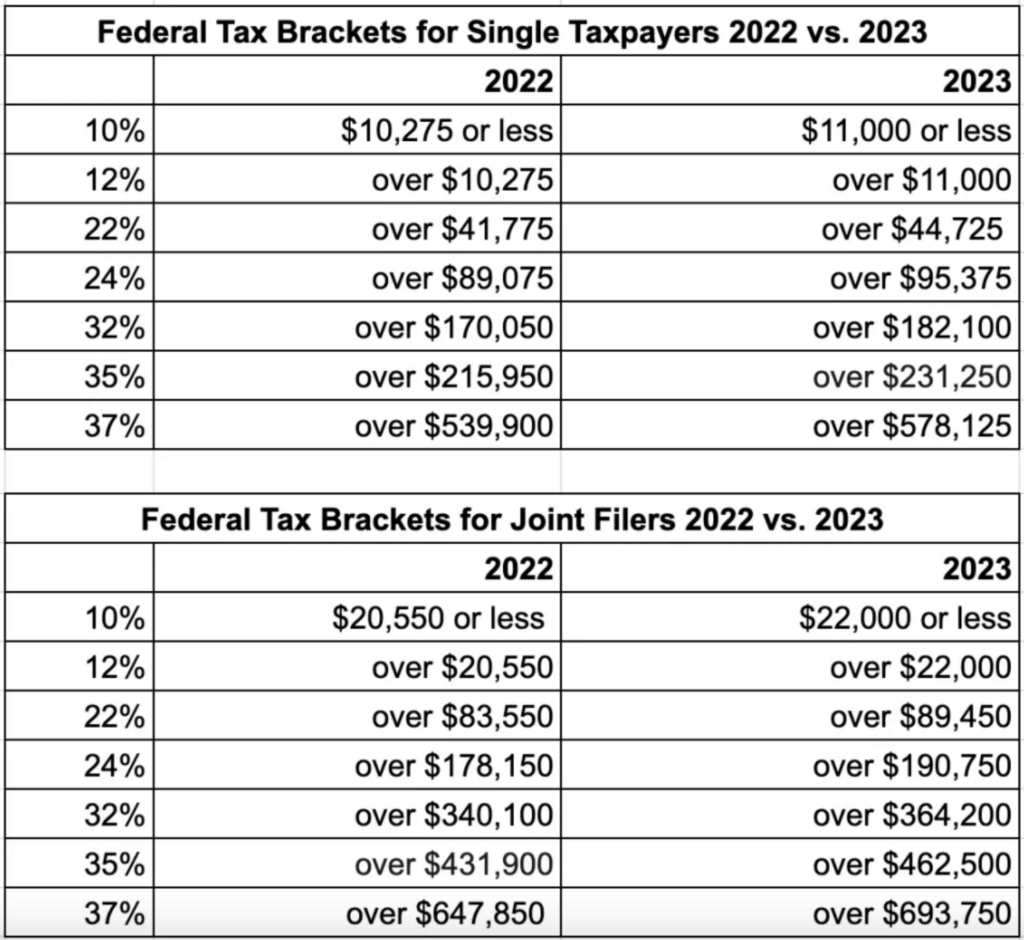
According to the IRS, the income thresholds for all brackets will increase as follows:

Remember: These are progressive marginal rates. It doesn’t mean that, if you have $100,000 in taxable income as a single taxpayer, you’re taxed at 24% on that entire amount.

Instead, the first $11,000 is taxed at the 10% rate in 2023, the next dollars up to $44,725 are taxed at 12%, the next dollars up to $95,375 are taxed at 22%, and the last dollars over $95,375 are taxed at 24%.

What these increases mean for you

According to the latest Bureau of Labor Statistics data, wages only increased 4.4% for the 12-month run ending September 2022, up just 2.4% from a year earlier. Though some folks saw a jump in their salaries last year, most of those gains still fell behind rising inflation levels.

“The whole point of adjusting tax brackets for inflation is to reduce the impact or mitigate the impact of inflation,” topld Eric Bronnenkant, head of tax at Betterment. “Let’s say some people got a 10% raise in wages last year, while others may have not gotten any raise at all. Arguably, people whose income outpaced the estimated inflation hike of 7% now may be paying more taxes because their tax bracket is higher, while those with wages with little growth may be paying less.”

What this means is that taxpayers whose salaries didn’t keep up with inflation are able to bypass bracket creep. According to the Tax Foundation, this occurs when inflation pushes you into a higher income tax bracket, which will reduce the value of credits, deductions, and exemptions.

“You still have to remember that a 7% tax bracket increase is still a rough estimate of inflation, and it’s never about any one person’s individual situation,” Bronnenkant said. “It’s possible that inflation was low, but you lived somewhere where your landlord increased your rent 10% and your personal costs may have increased a lot. It’s not perfect for everybody, but it’s the best the IRS can do to average inflation for a large amount of people.”

Source: finance.yahoo.com

Signature Bank Halts SWIFT Transactions Under $100,000 for Crypto Users, Says Binance

Signature Bank’s customers facilitating fiat operations with Binance will not be able to make SWIFT transfers of less than $100,000, according to the crypto exchange.

“One of our fiat banking partners, Signature Bank, has advised that it will no longer support any of its crypto exchange customers with buying and selling amounts of less than 100,000 USD as of February 1st, 2023,” a Binance spokesperson said in an emailed statement to Decrypt. “As a result, some individual users may not be able to use SWIFT bank transfers to buy or sell crypto with/for USD for amounts less than 100,000 USD.”

SWIFT is a vast messaging system that allows banks and other financial institutions from all around the world to send and receive encrypted information, namely cross-border money transfer instructions.

Only 0.01% of Binance’s monthly users are served by Signature Bank. Other Binance banking partners have not been affected, the exchange noted, adding that it is “actively working to find an alternative solution” for affected users.

“Furthermore, all other Binance functions are unaffected by this change, and all users can continue using their accounts. Notably, buying and selling crypto using credit or debit cards, using one of the other fiat currencies supported by Binance (including Euros) and our Binance P2P marketplace will continue to operate as usual,” added Binance’s spokesperson.

Decrypt didn’t immediately hear from Signature Bank after reaching out for additional comment.

Signature Bank steps back from crypto

Signature Bank has been hit hard by the recent turmoil in the crypto industry, as per its latest fourth-quarter filing.

In the final quarter of 2022, the firm announced a decline in customer deposits of roughly $14 billion, citing its “planned reduction in digital asset banking deposits” alongside industry-wide chaos. Last quarter, markets were rocked by the high-profile collapse of FTX and a suite of legal charges against the exchange’s disgraced founder, Sam Bankman-Fried.

Despite a hefty rally year-to-date, with Signature Bank stock (SBNY) rising from $113 on January 3 to $127 on January 20, the past year has been brutal for the bank.

On January 24, 2022, the NASDAQ-listed stock traded at more than $314.

Source: finance.yahoo.com

3 Best-Performing REITs With Dividend Yields Above 8%

One of the best things about real estate investment trusts (REITs) is the diversity of property types, which allows investors to choose subindustries as well as the ability to choose an investment based on its dividend income or recent momentum.

Some income investors buy REITs strictly for high-yielding dividends. Other REIT investors look for ongoing growth. But every once in a while, it’s possible to get both.

Take a look at three distinct REITs with dividend yields above 8%. Each underperformed in 2022 but have recently been one of the best REIT performers over one- and four-week time frames.

Western Asset Mortgage Capital Corp. (NYSE: WMC) is a Salt Lake City-based diversified mortgage finance REIT (mREIT) with an emphasis on procuring undervalued mortgage assets. Western Asset Mortgage Capital is externally managed by Western Asset Management Company LLC, which invests in agency residential mortgage backed-securities (RMBSes), nonagency mortgage-backed securities (MBSes) and asset-backed securities (ABSes).

Western Asset Mortgage Capital suffered through a terrible 2022, losing 54.5% from January through mid-December. Since that time, it has a four-week gain of 19.95% and has risen 8.05% over the past five trading days.

The dividend of $0.60 per share was cut to $0.40 per share in April 2022 but has been stable since then. The $1.60 annual dividend per share yields 15.4%.

Global Medical REIT Inc. (NYSE: GMRE) is a Bethesda, Maryland-based healthcare REIT that owns specialized facilities it leases to healthcare systems and physician groups. Global Medical REIT owns and operates 189 buildings with over 4.8 million net leasable square feet across the U.S. It has an average rent escalation of 2.1%.

Global Medical REIT pays a quarterly dividend of $0.21, or $0.84 annually, which presently yields 8.01%. In 2022, Global Medical REIT had a total return of negative 42.35%.

But over the past five days, Global Medical REIT has risen 5.22% and has produced a four-week gain of 13.41%.

Office Properties Income Trust (NASDAQ: OPI) is a Newton, Massachusetts-based real estate company that owns, leases and manages office space. Its 162 properties across 31 states have a solid tenant base, including a high percentage of government offices.

Despite this, Office Properties Income Trust has had declining revenue and volatile earnings per share (EPS) over the past three years. Its occupancy rate of 90.7% is still a bit low but represents a recent increase from 89.4%.

Office Properties Income Trust pays a $0.55 quarterly dividend per share, or $2.20 annually, that presently yields 12.9%. Office Properties Income Trust was down about 40% in 2022, touching a 52-week low in mid-October of $12.21, but has since bounced back to over $17 per share.

As for performance over shorter time frames, Office Properties Trust has gained 4.41% over the past five days. The four-week gain of 24.71% is even more impressive.

There is always a cautionary note to be made with very high-dividend yields, as some companies have high yields because of poor performance and may be at risk of dividend cuts. Investors should always perform adequate research and due diligence before investing in any stock but especially those with very high-dividend yields.

Source: finance.yahoo.com

Netflix: Password sharing ‘undermines’ business, warns crackdown will intensify

Netflix (NFLX) freeloaders, beware! The company is ramping up its password sharing crackdown.

Following fourth quarter earnings results on Thursday that saw subscriber numbers leap past expectations, the company warned in its quarterly letter to shareholders it will be intensifying its push to combat password sharing.

“Later in Q1, we expect to start rolling out paid sharing more broadly. Today’s widespread account sharing (100M+ households) undermines our long term ability to invest in and improve Netflix, as well as build our business,” Netflix said.

The company explained it’s been building additional new features to improve the overall Netflix experience, including the ability for members to review which devices are using their account and to transfer a profile to a new account.

Members can also pay extra if they want to share the platform with people they don’t live with.

“As we work through this transition – and as some borrowers stop watching either because they don’t convert to extra members or full paying accounts – near term engagement, as measured by third parties like Nielsen’s The Gauge, could be negatively impacted,” Netflix said.

However, the company referred to its recent testing in Latin America, which showed engagement steadily increase over time as borrowers signed up for their own accounts and new content was released.

Investors will be closely monitoring the company’s earnings call for additional updates regarding its crackdown on password sharing, in addition to its newly launched ad-supported tier.

Netflix has looked at those two initiatives as profitability drivers, especially as competition within the streaming space escalates: “As always, our north stars remain pleasing our members and building even greater profitability over time,” the streamer said.

Quarterly net additions grew by 7.66 million, above company guidance of 4.5 million amid a slew of high-profile and record-breaking content releases, including “Glass Onion,” “Troll,” “All Quiet on the Western Front,” “My Name is Vendetta,” and “Wednesday.”

Although the company delivered a miss on both the top and bottom lines, guidance came in strong with revenue expectations for the first quarter of 2023 set at $8.17 billion with earnings per share expected to come in at $2.82.

Amid the earnings announcements, Netflix co-CEO and co-founder Reed Hastings announced he would step down from his role leading the company. COO Greg Peters will join current Netflix co-CEO Ted Sarandos in that role. Hastings will now serve as the company’s executive chairman.

Shares of Netflix were up as much as 6% in after-hours trading following Thursday’s results.

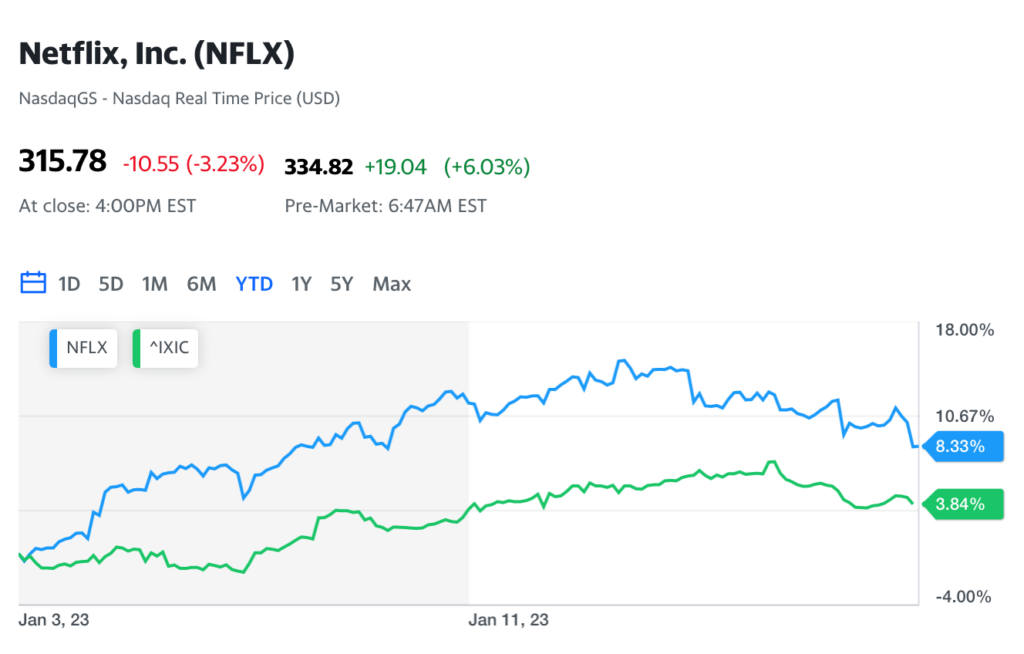
Netflix stock have been on a tear in recent weeks, up roughly 60% over the past six months with about a 10% gain so far in January, outperforming the Nasdaq Composite’s 5% gain.

Source: finance.yahoo.com

Netflix Q4 earnings preview: Investors eye ad tier update, continued subscriber gains

Netflix (NFLX) is set to report fourth quarter financial results after the bell on Thursday as investors seek greater clarity surrounding the streaming giant’s profitability efforts, including its crackdown on password sharing and its recently debuted ad-supported tier.

The Street will also continue to keep a close eye on subscriber numbers, which fell in each of the first quarters of the year, but are expected to grow again in Q4 after rebounding in the third quarter.

Here are Wall Street’s expectations for Netflix’s headline results, according to Bloomberg consensus estimates:

  • Revenue: $7.85 billion
  • Adj. earnings per share (EPS): $0.58
  • Subscribers: 4.5 million net additions

Although foreign exchange headwinds have been a pain point for the streaming giant, a weakening U.S. dollars should help boost revenue and operating income in the fourth quarter, with analysts from Goldman Sachs to Wells Fargo raising estimates for the streaming giant in recent weeks.

Netflix guided to subscriber additions of 4.5 million in October, though some analysts are looking for this figure to beat expectations amid a slew of high-profile and record-breaking content releases, including “Glass Onion,” “Troll,” “All Quiet on the Western Front,” “My Name is Vendetta,” and “Wednesday.”

Analysts at JPMorgan, for instance, are forecasting 4.75 million net paid additions for the company in its most recent quarter.

Investors will not see the full impact of Netflix’s foray into advertising within Thursday’s results given the tier just launched in November. However, data from third-party research firm YipitData points to increased momentum.

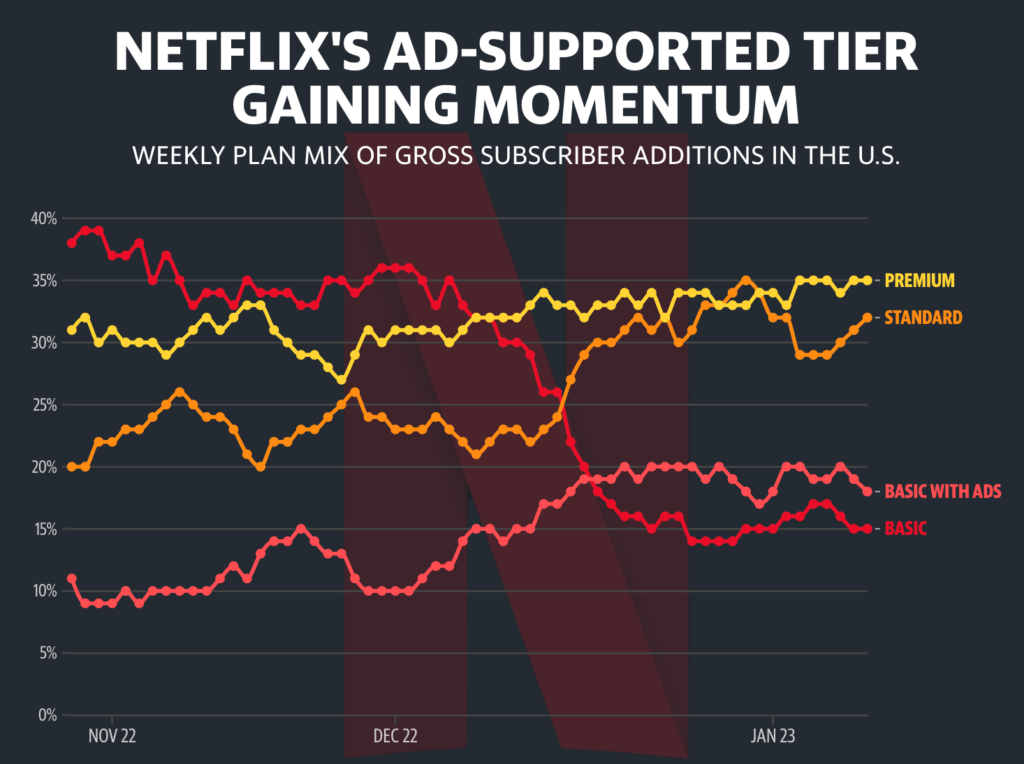
According to that data, Netflix’s ad tier has been modestly incremental to positive subscriber trends, and has not driven significant cannibalization of the standard and premium tiers — a previous concern on the Street.

Ad-based gross adds have gained traction throughout the quarter, comprising roughly 15% of total subscriber gross adds, YipitData added.

Overall, analysts have preached the long game to investors when it comes to advertising, with Wells Fargo’s Steve Cahall anticipating password sharing will be a bigger topic in the near-term.

“While much of the sellside and buyside focus of late has been the [advertising video-on-demand] launch, we actually think disclosure will be limited as will the impact on estimates. Instead, we think password sharing is the bigger catalyst near term,” Cahall wrote in a new note to clients. “As the Street better understands password sharing we see it as upside to revenue growth estimates.”

Netflix shares have been on a tear in recent weeks, up more than 60% over the past six months with a more than 10% gain so far in January, outperforming the Nasdaq Composite’s 5% gain.

Source: finance.yahoo.com

Oil Extends Decline on US Recession Concern, Inventory Build

Oil erased an earlier drop as signs of rising US inventories vied with expectations of more robust Chinese demand.

West Texas Intermediate was little changed above $79 a barrel. The American Petroleum Institute reported a 7.6 million-barrel gain in commercial stockpiles, according to people familiar with the data, reflecting the lingering impact of a December cold snap that shut down refineries.

Traders are expecting more robust Chinese consumption in the coming months as the country reopens from the pandemic. In physical markets, China’s Unipec has been snapping up cargoes of Upper Zakum oil from the United Arab Emirates, purchasing the equivalent of 9 million barrels, and boosting the value of some Middle Eastern crudes.

Thursday also marks the first day of a series of strikes in France, including at the nation’s refineries. While the first walkout will last only 24 hours, industrial action late last year shuttered much of the country’s crude processing, damping European demand and boosting fuel prices.

Crude has endured a bumpy start to the year, collapsing by 10% in the first two sessions only to rebound as China’s reopening dominated the trading narrative. The big swing-factor for the market is the demand outlook, with industrialized economies looking for a soft landing as interest rates rise and China emerges from Covid curbs.

“There is still a huge amount of uncertainty surrounding the global economy,” said Tamas Varga, an analyst at brokerage PVM Oil Associates Ltd. “Maybe the time was ripe for a bout of profit-taking, and the disappointing set of US economic data was the trigger-point. The medium-term outlook, however, remains buoyant.”

Source: finance.yahoo.com

Apple unveils host of Macs including new MacBook Pro with faster M2 chips

Apple has unveiled a host of new Macs, with what it says are dramatically faster new chips.

All of the new computers are powered by the new M2 Pro and M2 Max, high-end versions of the M2 chip that were first revealed in laptops last summer.

The new chips come in a variety of new computers: a 14-inch and 16-inch MacBook Pro, and new Mac Mini. All of those computers keep the same external design as before, but Apple promises they are much faster on the inside.

It is the first time that Apple’s Mac Mini has included the higher-end, “professional” versions of Apple’s chips, since it could previously only include the normal M1. It was one of the first computers to receive that M1 chip – the first of Apple’s processors to be designed in house – but has gone unchanged since that happened in 2020.

The new 14-inch MacBook Pro starts at $1,999, or £2,149, and the larger 16-inch model starts at $2,499 or $2,699. The Mac Mini with the normal M2 starts at $599 or £649, and the one with the M2 Pro costs $1,299 or £1,399.

All of them are available to order today and will arrive with customers and in shops next week.

The old versions of the computers have been removed from sale. That includes the Mac Mini that included the Intel chips that powered Macs before Apple introduced its own processors – leaving the Mac Pro as the only computer to keep that technology.

Apple claimed that the new M2 Pro is 40 per cent faster at Photoshop image processing than the the MacBook Pro with an M1 Pro inside of it, and it is 25 per cent faster at compiling new code in Xcode. Graphic speeds are up to 30 per cent faster, it said.

But Apple gave little more precise details about how much faster the new computers are than their predecessors. It announced the new computers in a press release, rather than a live event.

Apple did however post a video to its website, which looked as if it had been created for one of its full announcement events. Reports have suggested that Apple had been planning a January event to reveal its widely-rumoured augmented reality glasses – and the Mac-focused video may have been created for that.

The new chips do not appear to offer additional features or a new design when compared with both the M2 from last year and the M1 Pro and Max chips that first arrived in the larger versions of the MacBook Pro when they were unveiled in October 2021.

Instead, Apple indicated that the new chips were intended to build on that foundation but increase the performance. Taken together, the improvements mean that the new chips are “the world’s most powerful and power-efficient chip for a pro laptop”, Apple said, though it gave little information on how it had come to that conclusion.

Source: finance.yahoo.com

What Income Level Is Considered Rich?

Earning more money can make it easier to pay the bills, fund your financial goals and spend on hobbies or “fun,” but what income is considered to make you rich? The answer can depend on several factors, including where you live, what type of job you have, how much you save or invest and how you typically spend your money.

What Income Is Considered Rich?

Pinning down an exact income level that qualifies you as “rich” is difficult, as there are numerous studies and surveys that attempt to measure it. To keep things simple, let’s consider where the Internal Revenue Service (IRS) sets the bar for the top 1% of earners first.

According to the most recent data available for fiscal year 2019, an income of $540,009 per year puts you in the top 1% category. Based on that figure, an annual income of $500,000 or more would make you rich. The Economic Policy Institute uses a different baseline to determine who constitutes the top 1% and the top 5%. For 2021, you’re in the top 1% if you earn $819,324 or more each year. The top 5% of income earners make $335,891 per year.

What Is a Rich Monthly Income?

The amount of money you need to make each month to be rich depends on which metric you’re using. If you’re going by the IRS standard, then you’d need to make approximately $45,000 a month to be rich. On the other hand, if you’re aiming for the top 1% as measured by the EPI, you’d need a monthly income of $68,277.

To reach that level of income, you’ll likely need to have something more than the typical 9-to-5 job. Examples of people with monthly incomes in that range can include successful business owners, celebrities, athletes and online influencers or content creators.

How Much Income Do You Need to Be in the Top 20%?

The real median household income in the U.S. is around $71,000, according to the latest Census Bureau data. In order to be in the top 20% of income, you’d need to earn nearly double that amount or an average of $130,545 per year.

That’s according to a SmartAsset study of income distributions in the 100 largest U.S. cities. The study found a wide range of income distributions geographically, with residents of San Francisco needing an income of $250,000 or more per year to land in the top 20%. Meanwhile, you’d need an income of $70,444 to be a top 20% earner in Detroit.

It’s important to remember that the definition of what it means to be rich is subjective. Someone who makes $250,000 a year, for example, could be considered rich if they’re saving and investing in order to accumulate wealth and live in an area with a low cost of living.

Rich vs. Wealthy: What’s the Difference?

Being rich is one thing, but being wealthy can mean something entirely different. Someone who’s rich may have cash available to spend on luxury goods or take expensive vacations. A wealthy person, on the other hand, might be more focused on increasing their net worth and creating a long-lasting financial legacy.

So, what’s the cutoff to be considered wealthy? Again, it’s subjective and there are lots of different numbers that may be tossed around. Someone who has $1 million in liquid assets, for instance, is usually considered to be a high net worth (HNW) individual. You might need $5 million to $10 million to qualify as having a very high net worth while it may take $30 million or more to be considered ultra-high net worth.

That’s how financial advisors typically view wealth. The average American, on the other hand, sees $774,000 as a sufficient net worth to be financially comfortable and a net worth of $2.2 million to be wealthy.

How to Become Rich

If you’d like to reach millionaire status or join the ranks of the rich, you’ll need a strategy for achieving that goal. Short of winning the lottery or inheriting a fortune, becoming rich takes some effort. Just how much effort can depend on where you’re starting from.

Here are some of the most impactful steps you can take to become rich.

  • Earn more: Increasing your income means you’ll have more money to save, invest and pay down debt, all of which can help to boost your net worth. There are different ways to increase income, including negotiating a pay raise, pursuing higher-paying roles, taking on a part-time or second job and starting a profitable business or side hustle.
  • Budget: Budgeting is one of the simplest ways to take control of your money and become rich. When you budget, you’re deciding how to allocate the income that you have each month. That makes it easier to work toward your goals of saving and increasing your net worth.
  • Reduce debt: Your net worth is calculated based on how much you owe versus what you have in assets. Paying down debt can help you get on the path to becoming rich if you’re able to free up more money for saving and investing. If your debt is expensive due to high-interest rates, consolidating or refinancing it or using a 0% APR balance transfer could make it easier to pay down what you owe.
  • Invest: Investing and saving money are both important but they’re entirely different. When you save money, you’re typically putting it into a savings or CD account at your bank where it can earn a little interest. When you invest, you’re putting your money into the market where it has the potential to earn much higher returns. If you’re not investing yet, the easiest way to get started is to contribute to your retirement plan at work. You might have a 401(k), for example, which you can contribute to from your paychecks automatically. As an added bonus, your employer might match some of what you put in, which is free money for you. In addition to a workplace retirement plan, you can also begin building wealth through an Individual Retirement Account (IRA) or a taxable brokerage account.
  • Get professional advice: Talking to a financial advisor can help you formulate a plan for saving and investing in order to build wealth. Your advisor can also guide you through the basics of making a budget and creating a workable debt payoff plan.

The Bottom Line

In terms of what income is considered rich, there’s no single number to go by. How you define being rich for yourself can depend on the amount of money you need to feel financially comfortable and how you use the income and assets that you have. To one person it means not worrying about money while to others it just means having enough money in retirement to not impact their lifestyle. Once you define what rich means to you then you can build a financial plan to help you reach that goal.

Source: finance.yahoo.com

Mark Cuban tells Bill Maher that buying gold is ‘dumb’ — and wants bitcoin to keep plunging so he can buy more. Here are 3 simple ways to gain crypto exposure

Bitcoin plunged nearly 65% in 2022. But one billionaire investor still likes the world’s largest cryptocurrency: Mark Cuban.

“I want Bitcoin to go down a lot further so I can buy some more,” Cuban said in a recent episode of Bill Maher’s Club Random podcast.

Maher, who self-claims to be “very anti-bitcoin,” owns gold instead. Cuban, conversely, has no time for the yellow metal.

“If you have gold, you’re dumb as f—,” says the Shark Tank star and Dallas Mavericks owner.

Maher argues that gold “is like a hedge against everything else” but Cuban disagrees.

“[Gold] is not a hedge against anything, right? What it is is a store of value and you don’t own the physical gold, do you … Gold is a store of value and so is Bitcoin,” Cuban explains.

He then points out why gold can’t really protect your wealth in times of crisis.

“You don’t own the gold bar, and if everything went to hell in a handbasket and you had a gold bar, you know what would happen? Someone would beat the f— out of you or kill you and take your gold bar.”

If you share Cuban’s view, here are a few ways to gain exposure to bitcoin.

Buy bitcoin directly

The first option is the most straightforward: If you want to buy Bitcoin, just buy Bitcoin.

These days, many platforms allow individual investors to buy and sell crypto. Just be aware that some exchanges charge up to 4% commission fees for each transaction. So look for apps that charge low or even no commissions.

While bitcoin commands a five-figure price tag today, there’s no need to buy a whole coin. Most exchanges allow you to start with as much money as you are willing to spend.

Bitcoin ETFs

Exchange-traded funds have risen in popularity in recent years. They trade on stock exchanges, so buying and selling them is very convenient. And now, investors can use them to get a piece of the bitcoin action, too.

For instance, ProShares Bitcoin Strategy ETF (BITO) started trading on NYSE Arca in October 2021, marking the first U.S. bitcoin-linked ETF on the market. The fund holds bitcoin futures contracts that trade on the Chicago Mercantile Exchange and has an expense ratio of 0.95%.

Investors can also consider the Valkyrie Bitcoin Strategy ETF (BTF), which made its debut a few days after BITO. This Nasdaq-listed ETF invests in bitcoin futures contracts and charges an expense ratio of 0.95%.

Bitcoin stocks

When companies tie some of their growth to the crypto market, their shares can often move in tandem with the coins.

First, there are bitcoin miners. The computing power doesn’t come cheap and energy costs can be substantial. But if the price of bitcoin goes up, miners like Riot Blockchain (RIOT) and Hut 8 Mining (HUT) are likely to receive increased attention from investors.

Then there are intermediaries like Coinbase Global (COIN) and PayPal (PYPL). When more people buy, sell and use crypto, these platforms stand to benefit.

Finally, there are companies that simply hold a lot of crypto on their balance sheets.

Case in point: enterprise software technologist MicroStrategy (MSTR). It has a market cap of under $2 billion. Yet its bitcoin count reached approximately 132,500 as of Dec. 27, 2022, a stockpile worth around $2.3 billion.

Source: finance.yahoo.com

Housing expert: ‘We can expect mortgage rates to go down’

Homebuyers may finally catch a break this year, says one expert, as signs of fading inflation could drive mortgage rates lower as soon as this month.

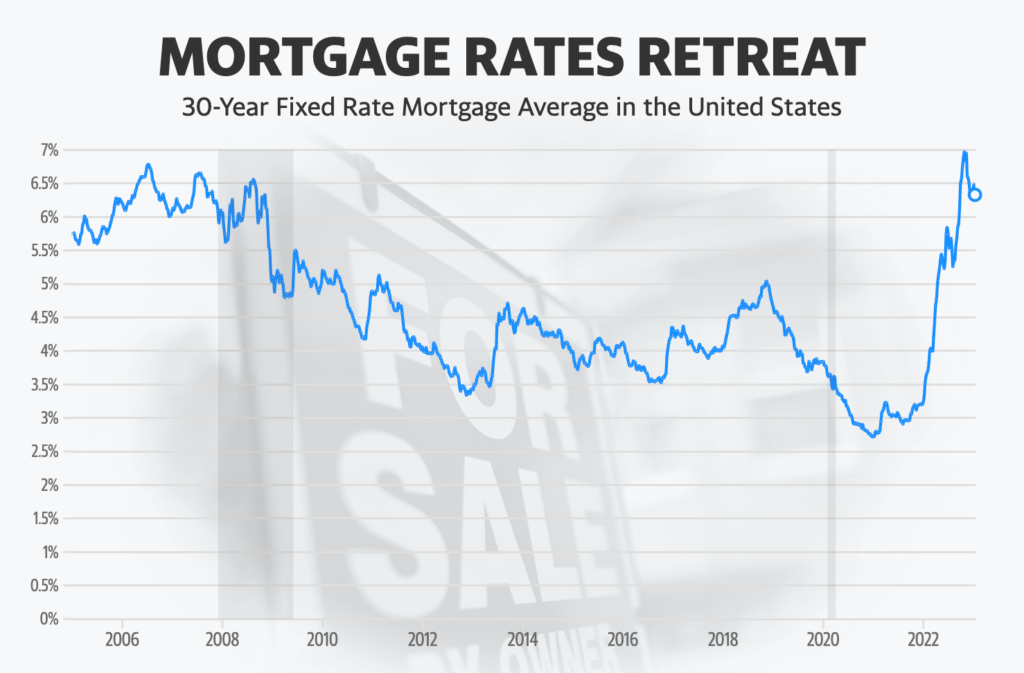
“Mortgage rates have declined by almost a full percentage point since they peaked in November,” told Melissa Cohn, vice president for William Raveis, a real estate brokerage firm. “I think that we can expect mortgage rates to go down another quarter or even as much as a half a percent over the course of the next month.”

The average interest rate on the 30-year fixed mortgage has fallen by three-quarters of a percentage point since mid-November, according to Freddie Mac, hitting 6.33% this week. The decline in rates comes after a series of government reports showed signs that inflation in the U.S. was finally cooling.

For some buyers, a mortgage rate drop means gaining back purchasing power and re-entering the market.

“It’s the beginning of 2023. Everyone is back to zero in terms of meeting their goals and everyone has to bring loans in the door,” Cohn said. “Banks are going to sharpen their pencils, they’re going to tighten up their margins, and do whatever they can to bring volume in the door and lower rates will bring more real estate transactions.”

Rates won’t drop to 3%

After roughly two years of record-low mortgage rates, the 30-year rate last year increased at their fastest clip in over 50 years. Most of the rate hikes were due to the Federal Reserve’s zealous fight against rampant consumer price growth.

However, signs of cooling inflation in recent months are increasing the likelihood that the Fed will reconsider its pace of hikes – giving mortgage rates a bit of relief. This week new data showed that consumer price growth had dropped to its lowest level in over a year.

Still, rates probably won’t return to levels seen during the early years of the pandemic.

“People can’t expect that we’re going to go back to a 3%, 30-year fixed rate,” Cohn said. “Now that happened because of COVID and the pandemic, and we don’t want to find ourselves in that position again. If we can get interest rates to go back to where they were pre-COVID, call that anywhere from 3.75% to 4.5%, that would be a home run.”

How to get the best interest rate

The combination of higher rates, climbing home prices, and inflation were a massive blow for plenty of first-time buyers last year, who were often priced out of the market.

While a rate drop can significantly boost your buying power, there are other ways you can improve your chances of snagging a lower rate. According to Cohn, the key is to start off early by improving your credit score.

“Many of the banks with better rates are going to want to see someone have three to four different active tradelines on their credit history,” she said, noting buyers should have sufficient money for the down payment plus extra. “We find a lot of first-time homebuyers getting stuck because they maybe have enough money for the down payment, but haven’t taken into consideration all of the closing costs and what you need to have for reserves.”

Another way to soften your rate is by considering an adjustable-rate mortgage or a government-backed home loan, which often carry lower interest rates and may be more accessible.

Finally, keep an eye on the demand in your area. Sellers have been more open to offering incentives, such as mortgage rate buy-downs, cash for closing costs, and even price reductions, so buyers still in the market should jump at those opportunities while they still can.

“When mortgage rates are higher, real estate prices tend to be a little bit softer,” Cohn said. “When interest rates do come dow … real estate prices will start to go back up again and there’ll be more competition for the homes on the market.”

Source: finance.yahoo.com