Snap earnings: Stock plunges following Q4 results

Snap (SNAP) reported its Q4 2022 earnings on Jan. 31, meeting analysts’ expectations on revenue and user growth, but clocking a net loss and weak guidance for this year’s Q1.

Here are the key numbers that emerged from Snap’s report, as compared with Wall Street’s estimates:

Q4 Revenue: $1.3 billion actual versus $1.31 billion expected

Adjusted Earnings Per Share (EPS): 14 cents versus 11 cents expected

Daily Active Users (DAUs): 375 million versus 374.7 million expected

The company also reported a net loss of $288 million, a stark comparison to the net income of $23 million that Snap reported this time last year.

Looking ahead, Snap’s Q1 2023 revenue guidance suggests a decline “between -10% to -2% year-over-year.” However, that’s an internal forecast and the company declined to provide an official one for the third straight quarter. The Los Angeles-based company added that it expects to see its DAUs grow to between 382 million and 384 million in Q1 2023.

“We continue to face significant headwinds as we look to accelerate revenue growth, and we are making progress driving improved return on investment for advertisers and innovating to deepen the engagement of our community,” CEO Evan Spiegel said in a statement.

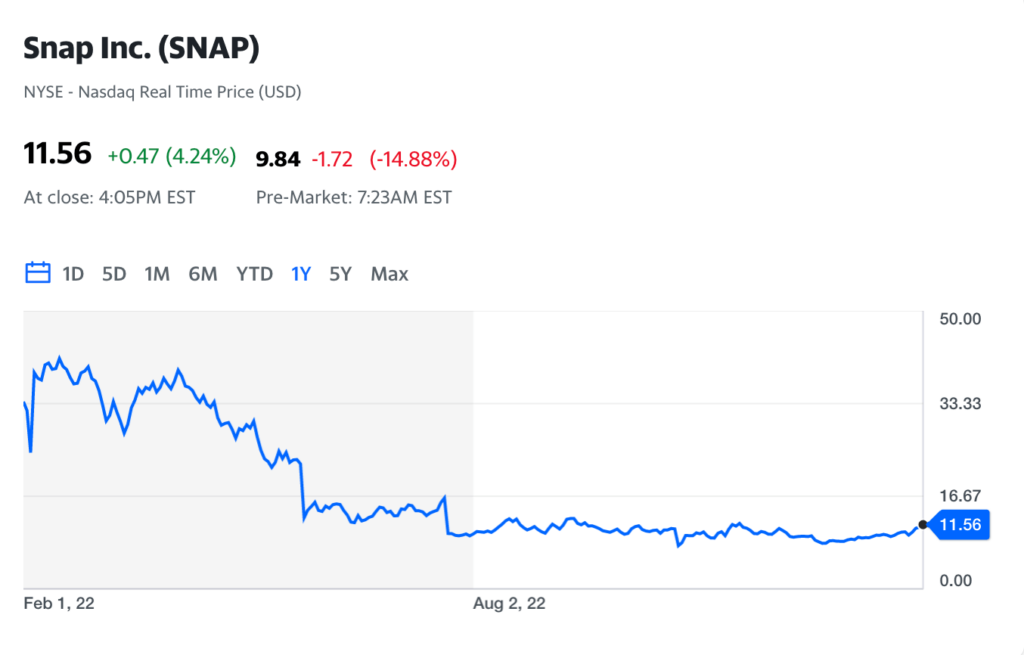
Snap stock plunged in after-hours trading by about 13%.

Snap’s 2022 ends with struggles that have dogged the company all year

Today’s results mark the end of a long 2022 for Snap. Even in a rough year for Big Tech as a whole, Snap’s year stood out as uniquely tough. The company’s shares tumbled around 80% throughout 2022, as it was rattled by slowed digital advertising, high inflation, and fast-growing competition from TikTok.

In August, Snap laid off 20% of its workforce, a move that affected 1,300 employees. The cuts were high-profile and included the axing its drone camera Pixy and Snap Originals, the exclusive short shows the company made with celebrities and influencers. Snap also shuffled its executive team around at the time.

The stakes were high for Snap today, as Wall Street’s grown increasingly skeptical of the company’s prospects. To that end, Snap has seen a number of downgrades recently, including from Citizens-owned JMP Securities and Jefferies.

Snap remains in the throes of the advertising slowdown and, if the company’s investor letter is anything to go by, they don’t expect that to let up anytime soon. Right now, advertising is Snap’s business. In Q4 2021, Snap said in SEC filings that “for the years ended December 31, 2021, 2020, and 2019, advertising revenue accounted for approximately 99%, 99%, and 98% of total revenue, respectively.”

Moving forward, look for Snap to tout and attempt to build efficiency in its advertising business.

“While we continued to face significant headwinds to our revenue growth in the quarter, we are optimistic about the improvements we are making to our direct response advertising platform and the early progress we have made improving return on advertising spend (ROAS) for our advertising partners,” Snap’s investor letter reads. “We believe that improving returns on advertising investments will enable us to continue to increase our share of wallet in this highly competitive environment.”

Source: finance.yahoo.com

This Online Brokerage Will Pay You $3,500 Just To Open An Account

Online brokerages are battling each other to win your account. And some are willing to pay up for it.

Surprisingly lucrative bonuses are up for grabs if you open an account with a brokerage or refer a friend to an online broker. Most of the major online brokerages are doing it, including E-Trade, Charles Schwab (SCHW) and Ally Financial (ALLY).

Morgan Stanley’s (MS) E-Trade is the most generous. It’s handing out up to $3,500 if you fund an account with $1.5 million or more.

But don’t worry. Even if you don’t have a million bucks sitting around, brokerages will still pay you.

In IBD’s 2023 Best Online Broker survey, respondents rated the attribute incentives/discounts/pricing 12th out of 18 traits. But everyone loves free money.

Online Brokerages: Bonuses Aren’t Just For Millionaires

Don’t assume you need to be a millionaire for brokerages to offer incentives for your account.

Take E-Trade, for instance. The brokerage pays up the more you put in, but still has attractive offers for lower amounts. E-Trade will pay you $50 for opening an account with as little as $5,000 in it. If you’re able to pony up $20,000 for a new account, that bonus doubles to $100. The bonus keeps rising, reaching $300 for a $100,000 account and $1,200 for a $500,000 account.

To get the bonuses, make sure you enter the BONUS22 code in your application. You must also fund the account in 60 days.

Investor Incentives

Some online brokerages, in fact, are paying ongoing incentives that might appeal most to newer investors with smaller account balances. Take Robinhood (HOOD), the app-based broker that caters to beginning investors. In December, the company launched its new individual retirement account (IRA) offering to help customers save for retirement. Robinhood will match contributions by 1%.

What does that mean in dollars and cents? If you contribute the maximum $6,000, Robinhood will put an extra $60 in your account. “This is not a one-time promotion, but rather a sustainable feature within the Robinhood Retirement account,” said Robinhood spokeswoman Jacqueline White. It’s sustainable because Robinhood keeps contributing to your IRA over time.

“Online brokerages used to offer free trades to attract new clients, but with trade commission for the most part already at zero, they need to find other ways to entice investors to select them,” said Mike Foy, senior director of wealth intelligence at J.D. Power. “Cash offers are common, and some firms are even getting more creative — like Robinhood’s recent announcement that they will match (a portion of) some client IRA contributions.”

Firms are betting that if they can attract assets now, over the long term they will be able to monetize them through selling more fee-based services, including advice and guidance as many investors find they need more help as their wealth grows and their needs become more complex over time. And there’s some evidence that this may be an effective strategy going forward — one example is that we see four out of five (81%) Gen Y DIY investors say they would be interested in an automated or robo-investing service if their firm offered it.”

Sizing Up Online Brokerages’ Offers

Even the largest and most established online brokerages will make it worth your while to work with them.

Charles Schwab, which consistently ranks well in IBD’s Best Online Brokers survey and led the pack in this year’s survey, offers a number of bonuses. Open a new account with at least $50 in the Schwab Starter Kit program, and you can get a bonus of $101. The bonus is put into your new account and you can use it to buy “stock slices,” or a mutual fund-like basket of a number of large stocks.

But Schwab’s potentially most lucrative offer is a bonus of up to $1,000 if you open an account after being referred by an existing Schwab client. The bonus varies based on how much you put in your Schwab account.

The bonus is $100 if you deposit $25,000, going all the way up to $1,000 if you open a $500,000 account. To get your bonus, make sure you get a referral code from the existing Schwab member and fund the account in 45 days.

Just know that bonuses are constantly changing and can vanish at any time.

Fidelity, another top-rated online broker with IBD survey respondents, offered a bonus of $150 for people who opened accounts with at least $50 in its holiday-themed Starter Pack offer. But that offer expired in early December. It has since renewed it. And not all brokers offer bonuses, including Interactive Brokers (IBKR).

Know The Risks

Additionally, most bonuses have stipulations attached that you must follow. Most commonly, you have roughly a month to get the money into the account to get the bonus.

And if you’re planning to close your existing account and move your money, you might face a fee on the way out. Online brokers might charge $50 or more if you transfer your account, sometimes called an ACAT transfer fee. You might be able to avoid the fee if you only transfer part of your old account, not the whole thing.

But there’s also a bonus to help with the fee, too, if you must pay one. For example, if you move an account worth $2,500 or more to Ally Invest, a unit of Ally Financial (ALLY), it will reimburse transfer fees up to $75.

Source: investors.com

Stock market: 3 stunning stats from January 2023’s spirited move

Investors have had a slew of downbeat headlines to kick off 2023.

Eye-popping layoff news from tech stalwarts Amazon, Microsoft, Salesforce and 3M. Chip giant Intel reported another tough outlook amid a major slowdown in PC demand. Ford and Tesla slashing prices on EVs as the economy has cooled. Signs that inflation continues to slow — but not at such a rapid pace as to suggest rate cuts from the Federal Reserve later this year. Earnings are meh.

And yet stocks are off to a surprisingly solid start to the year.

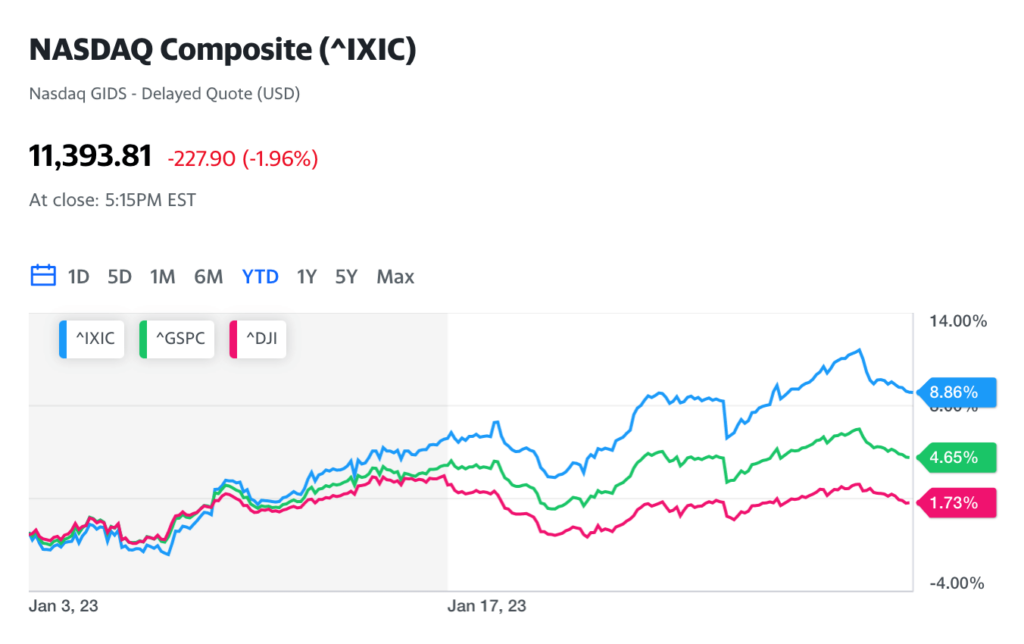
As of this writing, the Nasdaq Composite has posted a nearly 9% gain so far in 2023. The S&P 500 and Dow Jones Industrial Average have clocked in with 4.65% and 1.7% advances, respectively.

It’s unclear if January will be as good as it gets for stocks this year or the party will continue — in any case, the action has been interesting to watch. Here are a few interesting stats from 2023 served up by astute market strategist Keith Lerner at Truist:

1.Investors are feeling the forgotten.

The 50 worst-performing stocks of 2022 are up an average of 20.1% so far this year, according to Lerner’s research. The 50 best-performing stocks from last year, meanwhile, are up an average of only 1.9%.

“We view this as most likely a short-term reversion of oversold stocks as opposed to new market leadership or a fundamental shift,” Lerner says.

2.Investors pump up PEs.

Analyst earnings estimates for the S&P 500 have ticked down to an 11-month low, Lerner noted. So, the advance in stocks has been fueled by rising price-to-earnings multiples — likely on the hope the Fed halts its rate hikes mid-year.

The S&P 500’s forward PE ratio has jumped back to 17.9 times, near the peak level of 18.0x-18.5x it traded to over the past decade outside of the pandemic highs.

“While this is typical during the early stages of a new bull market, since prices tend to advance well before earnings and the economy turn up, we remain skeptical,” Lerner wrote. “Our view is investors, as reflected in rising valuations, are placing too high of a probability on a soft economic landing and leaving little margin for error.”

3. ‘indiscriminate buying’

Going back to the previously out-of-favor stocks…

Lerner notes that “remarkably,” all 50 of last year’s worst performing stocks are up in 2023.

The appetite to buy these names “indiscriminate buying”, Lerner says.

Source: finance.yahoo.com

Memory-Chip Makers Face a Prolonged Price Slump

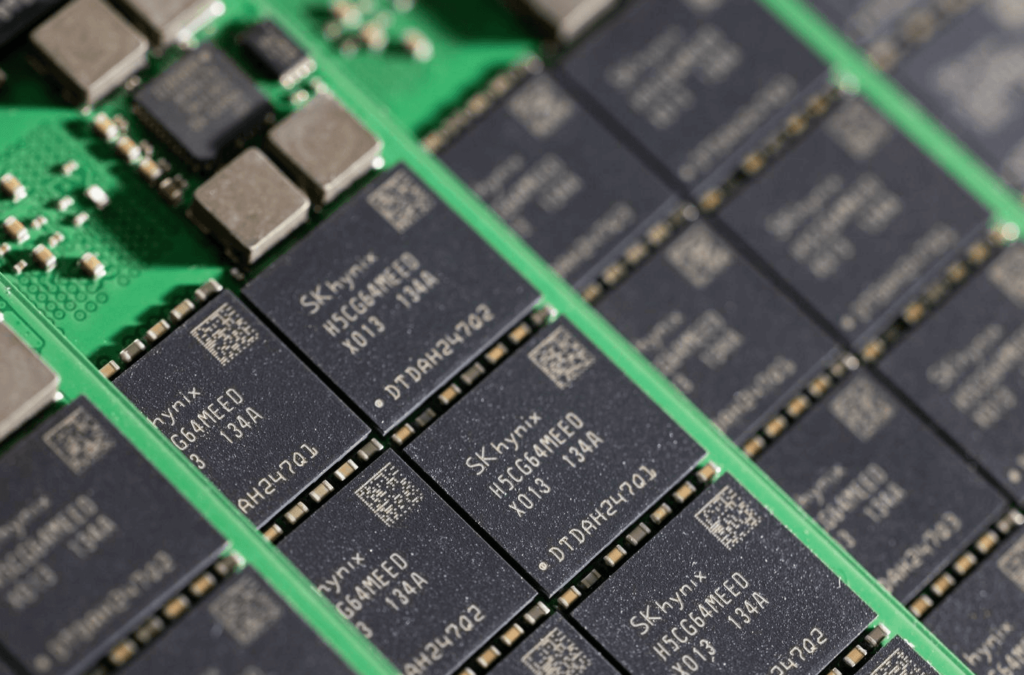
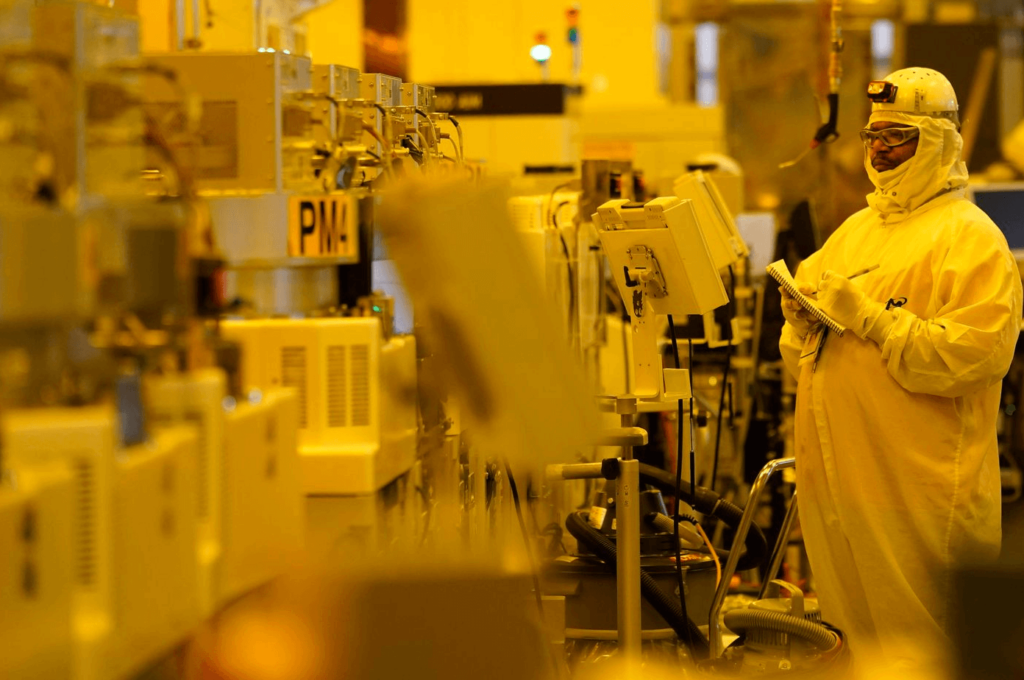
Memory-chip prices, which dropped steeply over the past year, are expected to keep falling in the first half of 2023, putting more pressure on an industry that has already cut investments and jobs.

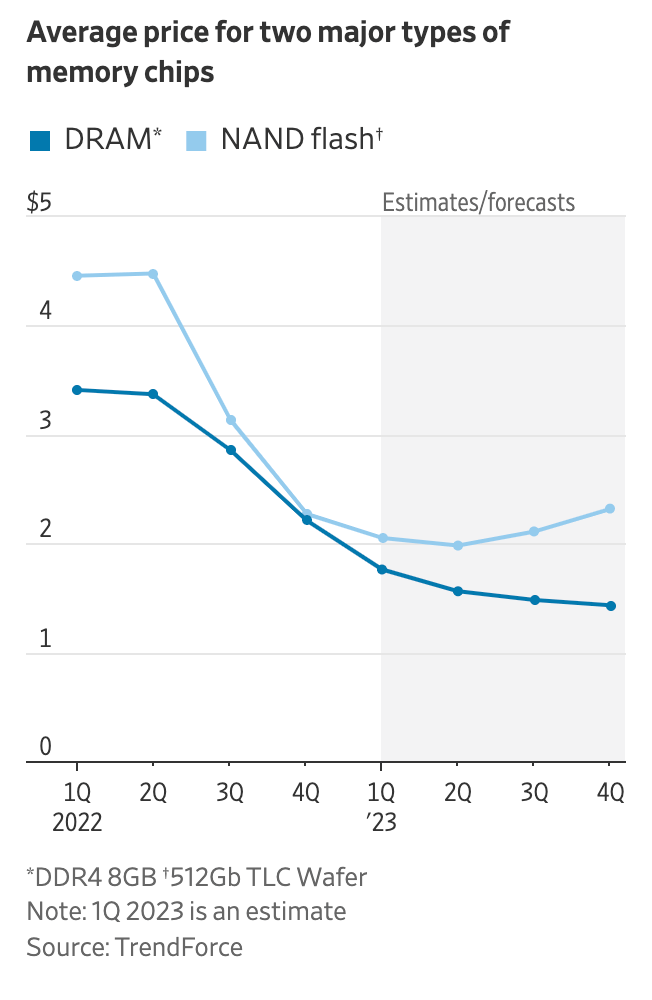
Average prices for the two main types of memory chips used in everyday electronics—from smartphones to personal computers and TV sets—are projected to experience double-digit percentage declines this quarter, industry analysts say. That comes after prices dropped by more than 20% in the last three months of 2022 from the previous quarter, according to analyst data.

Memory-chip makers, many saddled with large inventories, have also issued grim outlooks as the slump in demand for gadgets persists after a pandemic boom.

Micron Technology Inc., MU -2.46%decrease; red down pointing triangle SK Hynix Inc., 000660 -0.87%decrease; red down pointing triangle Western Digital Corp. WDC -1.65%decrease; red down pointing triangle and Tokyo-based Kioxia Holdings Corp. have unveiled plans to reduce their investments aimed at capacity expansion or to lower output to address a supply glut that is getting worse. Last month, Micron Technology said it would cut jobs and spending for the year to reduce costs after reporting a loss in its most recent quarter.

Memory chips are considered a bellwether for the semiconductor industry because they are more commoditized and sensitive to shifts in supply and demand.

Samsung Electronics Co., SSNHZ 0.00%increase; green up pointing triangle the world’s largest producer of memory chips, reports earnings Tuesday after saying earlier this month that its operating profit for the October-to-December quarter was expected to drop by 69% from a year earlier to 4.3 trillion won, which is equivalent to roughly $3.5 billion.

SK Hynix, which reports earnings Wednesday, is expected to report a fourth-quarter loss of around 812 billion won, or about $661 million, according to analyst projections averaged by FactSet.

Companies making other types of semiconductors are also caught up in the downturn. On Thursday, Intel Corp. reported a fourth-quarter loss and said poor market conditions would persist through the first half of the year.

Memory prices peaked during the early Covid-19 pandemic due to strong demand for tech products and they began falling in late 2021. Quarter-on-quarter declines got steeper through the second half of last year, as macroeconomic woes and rising interest rates combined with geopolitical uncertainties from the Russia-Ukraine war and China’s Covid lockdowns.

The memory-chip industry started 2023 with high inventories, said Kim Soo-kyoum, associate vice president covering memory semiconductors at International Data Corp., a tech market research firm. With demand still sluggish, memory prices are expected to keep declining throughout this year, though the quarterly drops could narrow or flatten in the second half depending on how soon buyers come back, Mr. Kim said.

Average contract prices for the two main types of memory chips, DRAM and NAND flash, dropped by roughly 23% and 28% respectively during the October-to-December period from the prior quarter, according to TrendForce, a Taiwan-based market researcher that tracks memory prices.

DRAM memory enables devices to multitask, while NAND flash memory provides storage capacity on devices.

Prices for both will likely keep falling through the first half of this year, TrendForce said. DRAM prices are expected to drop—on a quarterly basis—by 20% in the first quarter and 11% in the second quarter, while NAND flash prices during the same time frame are projected to drop by about 10% and 3%, respectively.

Inflation, high interest rates and weak economies are expected to continue to drive pullbacks in corporate and consumer spending on products including smartphones, PCs and data servers that are the biggest users of memory chips, TrendForce said.

DRAM prices are expected to continue dropping through the second half of this year and production cuts on a massive scale would be needed to shore them up, said Avril Wu, a TrendForce senior vice president.

Prices of NAND flash, however, could start to rebound starting in the second half as steeper price falls in recent months had prompted vendors to pursue more aggressive supply cutbacks for 2023, Ms. Wu said.

Samsung, the biggest producer of both types of memory chips, hasn’t publicly committed to moves that could reduce supply. In its last earnings call in October, Samsung’s memory-business Executive Vice President Han Jin-man said the firm was “not considering any artificial reduction in production for the sake of short-term, supply-demand rebalance.”

A Samsung spokeswoman said the company’s stance hasn’t changed.

In a report last month, Goldman Sachs forecast Samsung’s semiconductor unit’s operating profit for the October-to-December quarter would be around 1.5 trillion won, or roughly $1.2 billion, an 83% drop from a year earlier. It also projected Samsung’s memory business would record an operating loss starting from the first quarter of this year due to steep losses in the NAND flash business.

Global tech demand could recover later this year, aided by factors like China’s reopening after a period of strict Covid-19 restrictions which could revive consumer spending on products like smartphones, said David Tsui, senior credit analyst at S&P Global Ratings.

For now, it isn’t clear how quickly and to what extent consumer behavior would change in the country, he said.

Source: finance.yahoo.com

3 Supercharged Electric Vehicle Stocks to Buy in 2023 and Beyond

While 2022 was a year for stock price corrections across the electric vehicle (EV) sector, 2023 looks to be a transition year for the businesses themselves. EVs are going mainstream as manufacturers across the globe are ramping up production.

EVs made up 10% of all new cars sold globally last year. Europe and China are leading the way, with fully electric vehicles accounting for 11% and 19% of all new vehicles sold, respectively. With stock prices down and sales continuing to pick up, investors should look at investing in a diverse mix of EV makers in 2023.

Results matter, not expectations

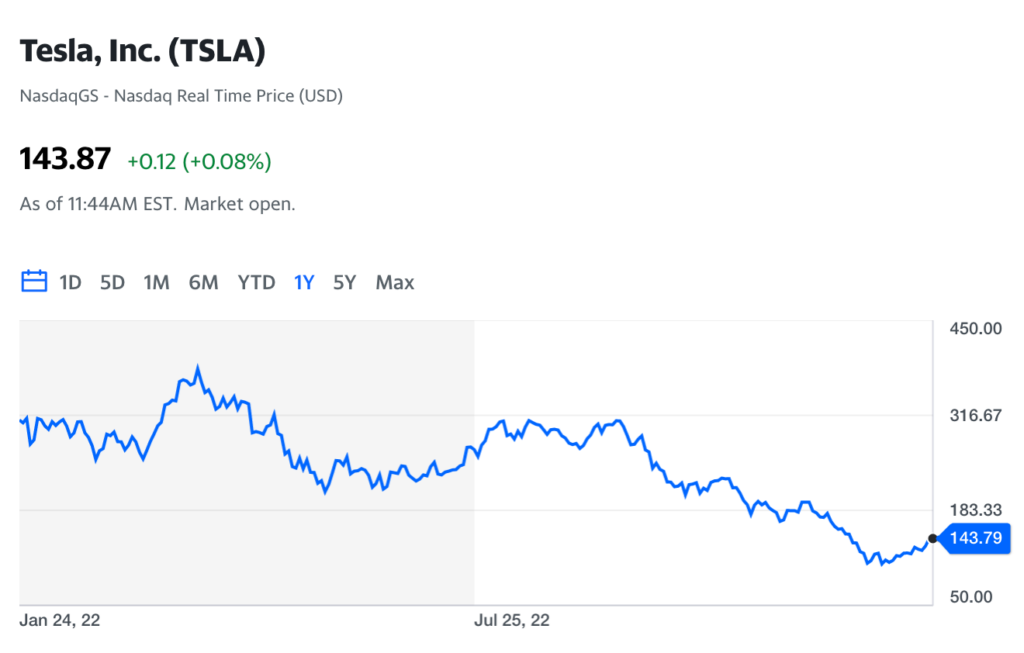
Tesla (TSLA -0.59%) is starting out 2023 proving that it remains the industry leader. It is so far ahead of the competition that it almost has to have a place in any basket of EV holdings. Even after a small recovery to start 2023, Tesla shares are still down almost 60% over the past 12 months.

But Tesla’s business remains strong. Maybe not as strong as some analysts and investors hoped, but that’s why the shares have become much more reasonably priced. Some feared Tesla’s vehicle price cuts across its sales regions indicated a drop in demand that signals a slowing business. But investors should look at results, and not just what prior expectations from analysts have been.

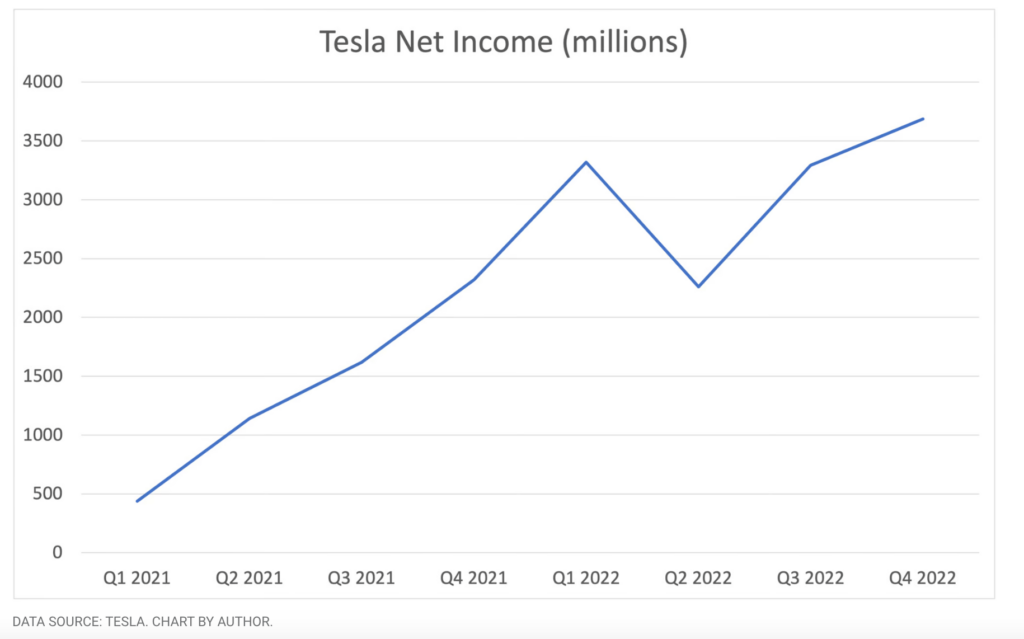
Increasing competition, and the resulting decrease in its market share, were inevitable. But Tesla generated $7.6 billion in free cash flow in 2022 even as it continues to invest for growth. The fourth-quarter results it recently released show its strategy to lower prices as much as 20% is one where it can still be a very profitable, high-growth business. Even with headwinds and price cuts in China, Tesla’s net income continued to grow in the fourth quarter.

Its strategy is to attempt to hold market share and deliver high volumes of vehicles. Even as its margins slide somewhat, Tesla will have those customers and potentially be able to upgrade those units with higher-margin automation in the future. It’s still a long-term growth story one should own.

Invest in the biggest markets

One company that is working to battle Tesla for market share in the biggest global markets is China-based Nio (NIO -3.74%). Nio boosted production, launched new models, and gained traction in the European market in 2022. The company is now squarely embedded in the two biggest global automotive markets.

Nio is a much more speculative investment than Tesla, though. Nio shares are also down about 60% over the last year, but unlike Tesla, it has yet to make a profit. Due to rising costs and production delays from COVID-19 impacts in China in 2022, the company reported a net loss of almost $1.3 billion in just the first nine months of the year. But growth is still accelerating for Nio, and total revenue is expected to be about $7.5 billion from 2022 sales.

With the stock’s decline over the course of the company’s struggles last year, its valuation has reached a reasonable level for a speculative investment. Nio’s price-to-sales (P/S) ratio is now below 3.0, which is less than half that of Tesla. That makes it an intriguing addition to a mix of EV stocks to buy in 2023.

True diversity

Ford (F -1.62%) could also be a good addition to that mix. It not only is quickly growing sales of its brand new lineup of electrified vehicles, but it also offers real diversity in a mix of EV names. That’s because Ford doesn’t intend to end sales of its internal combustion engine vehicles. Its initial electric offerings are also a mix of the Mustang Mach-E SUV, F-150 Lightning pickup truck, and E-Transit commercial van.

The F-150 Lightning has been named the MotorTrend Truck of the Year for this year, and interest is booming. It launched in May and has already become the best-selling electric truck in the U.S. Valuation certainly isn’t a disincentive to own Ford. It sports a P/S ratio of just over 0.3, or about one tenth that of Nio. Ford still needs to show it can earn a profit on its electric offerings, but considering the diversity it already offers, it also makes a good addition to a small basket of EV stocks worth buying in 2023.

Source: fool.com

These Stocks Are Moving the Most Today: Tesla, IBM, Chevron, ServiceNow, and More

Stock futures were mostly higher Thursday and tech stocks looked poised to rally after Tesla TSLA +0.38% delivered solid quarterly earnings.

These stocks could make moves Thursday:

Tesla (TSLA) was up more than 7% in premarket trading. The electric-vehicle maker reported fourth-quarter earnings that topped Wall Street estimates. Tesla’s operating earnings of $3.9 billion in the fourth quarter were a record.

International Business Machines IBM –0.52% (IBM) declined 2%. IBM posted better-than-expected quarterly revenue, and its revenue forecast also was upbeat. But the company’s outlook on free cash flow was slightly disappointing. IBM also said it would be cutting 3,900 jobs.

Chevron (CVX) was gaining 3% after the energy giant raised its dividend and announced a new round of buybacks valued at up to $75 billion.

ServiceNow NOW +1.21% (NOW) was down 1.7% even after the cloud-software company posted fourth-quarter earnings that were better than expected and its forecast for first-quarter subscription revenue also was higher than expectations.

Shares of Lam Research (LRCX) fell 1.9% after the silicon-foundry equipment supplier said it would be cutting its work force by 7% to reduce costs as chip equipment demand slows.

American depositary receipts of SAP (SAP) fell 4.4% after the German enterprise software giant announced plans to reduce its staff by 2.5%, and said it has begun exploring the sale of its majority stake in Qualtrics (XM).

American depositary receipts of Nokia (NOK) rose 3% after the Finnish telecommunications company beat analysts’ expectations for its fourth-quarter earnings and sales.

Las Vegas Sands (LVS) rose 2% after the casino company reported a fourth-quarter loss but said revenue jumped 11%. It also said it was confident that travel and tourism spending would continue to recover this year.

American Airlines (AAL) and Southwest Airlines (LUV) will be reporting quarterly earnings before the stock market opens Thursday.

Source: finance.yahoo.com

The 2023 stock market rally is facing its first technical challenge: Morning Brief

Stocks mounted an impressive comeback Wednesday, with the Nasdaq Composite (^IXIC) nearly erasing its biggest opening deficit since October. The Dow Jones Industrial Average (^DJI) eked out a small gain — its fourth straight — after spending most of the day in the red.

Even Microsoft (MSFT) rallied back from a 4.6% early loss to end the day down only about half a percent.

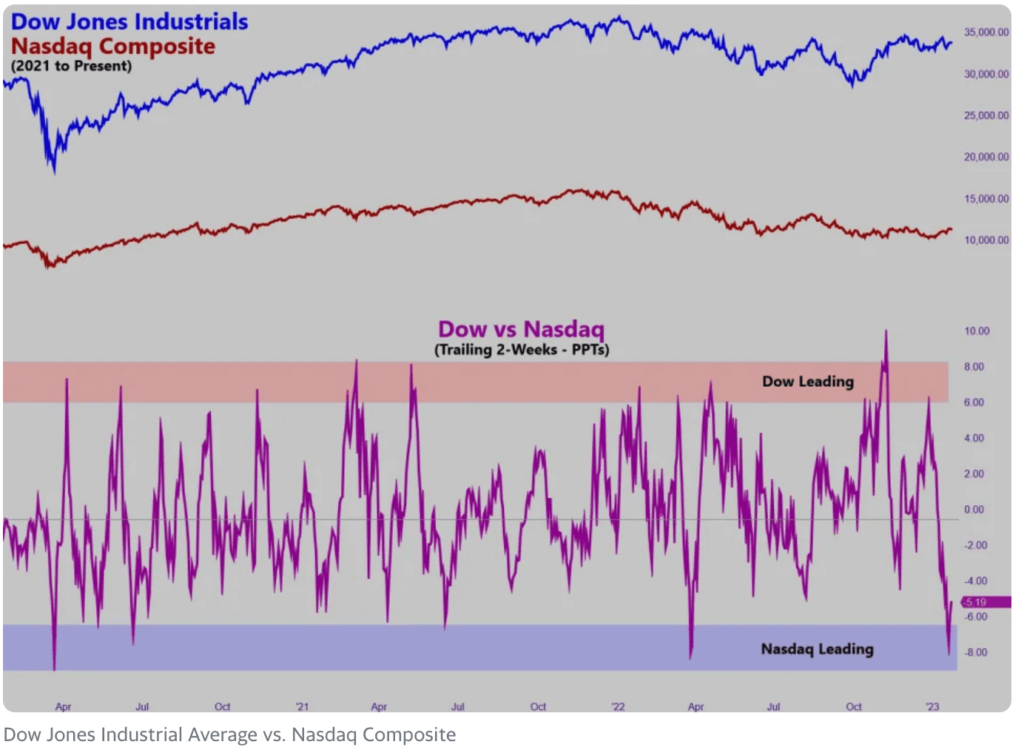
This year’s market action has been a reversal of one of last year’s most important trends, which saw the Dow outperform the Nasdaq by the widest margin in two decades.

This year, the Nasdaq is now up 8%, substantially outperforming the Dow’s return of just under 2%.

And while it’s unlikely a new bull market led by tech has begun, this relative performance is a tantalizing reminder of the gains tech bulls reaped in growth stocks during the ultra-low interest rate regime that had prevailed since the Global Financial Crisis.

And with several benchmark indexes right now at key levels, a squeeze out of current trading ranges would likely generate upside momentum.

First, take a look at the highly cyclical semiconductor space, where the PHLX Semiconductor Index (^SOX) is attempting to break out of a 9-month long inverse head-and-shoulders technical formation.

A breakout higher would suggest bulls retaking control after bears dictated price action for most of 2022.

If the majors follow suit and manage their own respective technical breakouts, those moves would likely generate significant momentum given the duration of the consolidation under current levels. The longer an index, stock, ETF, or any other traded asset consolidates around a particular price level, the stronger moves tend to be when the price breaks higher or lower.

For the S&P 500, the December highs around 4,100 mark the upper end of the current range; the index closed at 4,016 on Wednesday.

Meanwhile, Nasdaq has been constrained by 11,500 on the upper end since September, while the Dow has been stuck under 34,500 since April. These indexes closed at 11,313 and 33,743, respectively, on Wednesday.

However, it would be slightly unusual for risk markets to simply rally from here given how stretched the Nasdaq is versus the Dow — as evidenced by the below chart, which dates back to the beginning of the pandemic.

The Dow’s weakness in the face of Nasdaq strength this year appears to have reached a short-term extreme, and is in the process of reversing. And extreme readings have tended to coincide with short-term highs in stocks since the bear market got under way last year. However, during the pandemic bull market of 2020-2021, these extreme readings of relative outperformance tended to do little to dent the rally.

So, if the major indexes do roll over from here, tech and growth stocks would likely sell off more than cyclical and defensive names, allowing the Dow’s performance relative to the Nasdaq to normalize in the short-term. For those concerned with news and fundamentals instead of the technicals, the narrative to explain this price action would likely fixate around a hawkish Fed, higher rates, and disappointing earnings du jour.

Conversely, if chip stocks and the big benchmark indexes rip higher through current resistance, that would likely send the Dow-to-Nasdaq ratio sinking far below its current level.

The bottom line is that stocks could very well surge from here, and the technical setup suggests we’re a crucial juncture for this year’s market rally.

But any rally led tech stocks is likely to be fast, furious, and short-lived.

Otherwise, markets will need to consolidate and save energy for a more durable move higher another day.

Source: finance.yahoo.com
Intel may provide another earnings surprise for investors, analyst warns

Intel (INTC) may report another negative earnings surprise when it reports fourth-quarter results and guidance on Thursday, according to Citi.

“We expect Intel to guide below the normal seasonal range for 1Q23 revenue and EPS given continued weakness in the PC and data center end markets,” Citi chips analyst Chris Danely wrote in a new client note on Tuesday. “We expect Intel to give full year guidance and talk about a 2H23 recovery but we do not believe it will happen until 2024 and our estimates reflect that.”

Analysts are looking for first-quarter earnings of $0.26 on Intel and $1.81 a share for the full year, according to Yahoo Finance data. Reflecting the nervousness on Intel’s initial 2023 outlook, analysts have marked down their estimate by 7 cents compared to just 30 days ago.

Close followers of the Intel story over the past year may not be totally shocked if the tech giant disappoints given that the PC market remains under severe pressure as consumers hold back on upgrading their pandemic-bought models.

Global shipments of PCs crashed 28.1% in the fourth quarter of 2022, according to IDC. The research outfit estimates global PC shipments will fall 5.6% in 2023.

The marketplace weakness led to another challenging quarter for Intel and its rivals in the third quarter.

In late October, Intel trimmed its full-year profit guidance to $1.95 a share from $2.30 previously. The company promised $10 billion in cost cuts through 2025 to offset the top-line sluggishness.

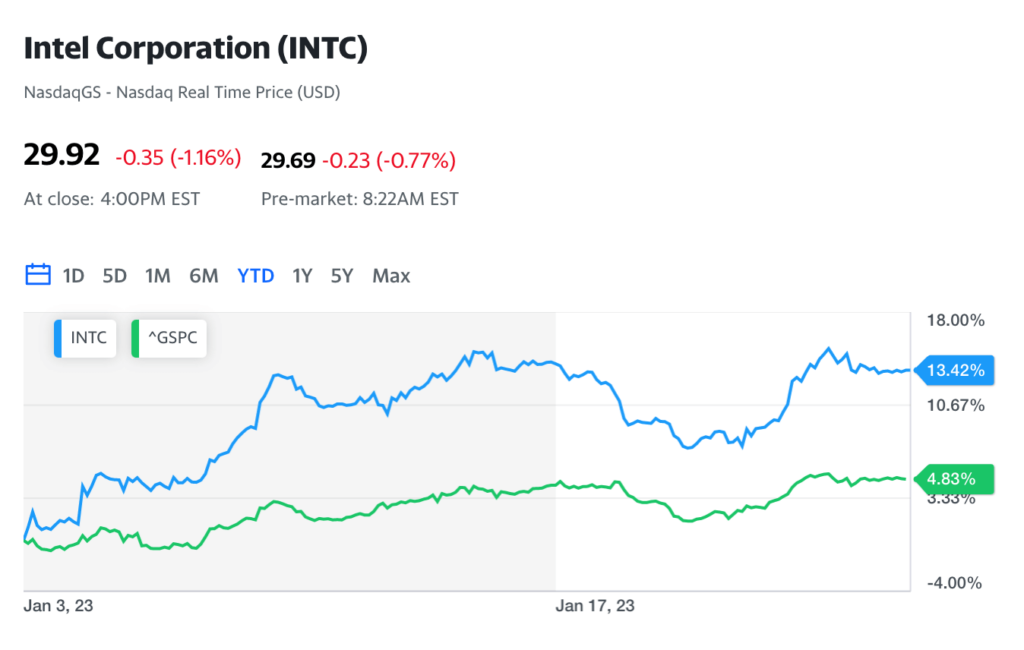
Danely added that Intel is likely to aggressively cut costs in 2023 to regain credibility with Wall Street — a factor that has helped propel the stock up more than 13% so far in 2023. But investors may stay locked in on market share loss for Intel versus AMD and how it stands to shape sales for the year.

“We believe there are more downsides to Consensus estimates given the PC and data center correction, in addition to market share loss,” Danely wrote.

Source: finance.yahoo.com
Buy Tesla stock ahead of earnings, analyst says

Bet the farm on battered Tesla (TSLA) stock ahead of the company’s hotly anticipated earnings report on Wednesday, contends Canaccord Genuity analyst George Gianarikas.

“Buy [Tesla stock] — it’s pretty simple,” Gianarikas said. “The stock had a pretty bad 2022 in terms of performance. That was based on multiple things, and some would attribute it to Elon Musk’s rantings on Twitter. We think it had a lot to do with the demand situation impacting Tesla, first in China and later kind of leaking into other parts of the world, including the United States. People know that. A lot of that seems to be priced into the stock.”

The bullish call on Tesla — which has become a rarity in recent months on the Street — runs counter to a host of red flags on the automaker’s fundamentals.

Tesla reported a delivery growth figure of 39% for 2022, which badly missed analyst estimates and fell below the company’s own guidance of 50%.

And earlier this month, Tesla cut the price of the Model 3 base version by $3,000 to $43,990 and the Model 3 Performance version by $9,000 to $53,990 in the U.S. As for the Model Y Long Range, the price dropped by $13,000 to $52,990 while the Performance model was cut to $56,990, about $13,000 cheaper than the prior price.

The U.S. discounts come hot on the heels of recent price reductions in China, Japan, and South Korea as Tesla looks to reignite demand against growing competitive threats.

Gianarikas said he believes the price cuts will stoke demand, even if it weighs on profit margins. The analyst is also bullish on the margin lift to Tesla from selling more software upgrades to customers.

Still, Tesla stock has plunged 54% over the past year, not helped by Elon Musk’s chaotic tenure as Twitter’s owner.

“Very simply, this is a fork-in-the-road year ahead for Tesla that will either lay the groundwork for its next chapter of growth OR continue its slide from the top of the perch with Musk leading the way downhill,” Wedbush analyst Dan Ives said in a more bearish note to clients this month. “Now is a time for leadership from Musk to lead Tesla through this period of softer demand in a darker macro and NOT the time to be hands-off, which is the perception of the Street.”

Source: finance.yahoo.com

2 Under-the-Radar Dividend Stocks With 8% Dividend Yields – or Better

While the big-name stocks may get the attention and the headlines, they’re not the only game in town. And sometimes, the market giants aren’t even the best place to turn for solid returns on that initial investment. There are small- to mid-cap stocks in the market that can present an unbeatable combination for income-minded investors: share appreciation and high-yielding dividend returns.

These stocks, however, can go undercover, slipping under investors’ radar, for numerous reasons, everything from living in unusual business niches to consistent failure to post profits, but sometimes the reason can be much more mundane: they’re just smaller companies. It’s inevitable that some sound equities will get overlooked.

Crescent Capital BDC, Inc. (CCAP)

We’ll start with Crescent Capital, a BDC firm that is part of the larger Crescent Group. Crescent Capital BDC offers a range of financial services to mid-market private enterprises, the type of companies that has long been drivers of the overall US economy but are frequently too small to access extensive credit and financing services from the traditional banking sector. Crescent serves this base through loan origination, equity purchases, and debt investments; the company’s portfolio totals over $1.29 billion in fair value and leans heavily toward unitranche first liens (62.7%) and senior secured first lien (25.4%).

Crescent Capital will be reporting its Q4 financial results in February; analysts are forecasting bottom-line earnings of 44 cents per share. It’s interesting to note that the company has beaten the EPS guidance by approximately 21% in each of the last two quarters reported. In the most recent, 3Q22, the company showed total investment income of $29 million, up 13% year-over-year, and a net investment income of $16 million, up 26% y/y. Net investment income per common share for Q3 came to 52 cents, compared to the 45 cents reported in the prior-year quarter.

Back in November, Crescent Capital declared its Q4 dividend, which was paid out this past January 17. The payment was set at 41 cents per common share, and the annualized rate of $1.64 gives a yield of 11.5%. This yield is nearly 5 points higher than December’s 6.5% annualized rate of inflation, and nearly 6x the average dividend paid by S&P-listed companies. It should be noted that, since Q4 of 2021, Crescent Capital has, in addition to its 41-cent regular quarterly dividend, also consistently paid out a 5-cent special dividend.

The Fed is committed to fighting inflation through increased interest rates, and Raymond James’ 5-star analyst Robert Dodd sees this as a net gain for Crescent. He writes, “Rising base rates should benefit earnings in 4Q22. The earnings benefit from higher rates is the plus side of inflation, the downside is margin pressure, and its impact on some portfolio companies. We do expect portfolio deterioration, and rising non-accruals as we head into the back end of the year (for all BDCs), but we believe that rate benefits will overwhelm the potential negative impact of non-accrual increases in the near/medium term.”

At the bottom line, Dodd says, “We see an attractive risk/reward, with positive rate sensitivity and strong credit quality — for a BDC trading at a material discount to current NAV/Share, and at a discount multiple to its peer group.”

Taking this forward, Dodd gives CCAP shares an Outperform (i.e. Buy) rating, and his price target, set at $18, implies that a one-year gain of ~25% lies ahead. Based on the current dividend yield and the expected price appreciation, the stock has ~36% potential total return profile.

Overall, this BDC has picked up 3 recent analyst reviews – and they are all positive, supporting a unanimous Strong Buy consensus rating. The shares are priced at $14.42, with a $17.67 average price target suggesting ~22% upside potential over the next 12 months.


Piedmont Office Realty Trust (PDM)

From the BDC world we’ll shift our focus to a real estate investment trust (REIT), another leading sector among dividend payors. Piedmont Office is a ‘fully-integrated and self-managed’ REIT, focusing on the ownership and management of high-end, Class A office buildings in high-growth Sunbelt cities such as Orlando, Atlanta, and Dallas. The company also has a strong presence in the northeast, in Boston, New York, and DC. In addition to existing office space, Piedmont has ownership of prime land plots, totaling 3 million square feet, for build-to-suit or pre-leased projects.

Come February 8, Piedmont is scheduled to release its 4Q22 and FY2022 results. The company has already published full-year guidance of $73 million to $74 million in net income, and core funds from operations per diluted share of $1.99 to $2.01. Keeping these numbers in mind, we can look back at 3Q22, the last quarter reported.

In that quarter, the company had a net income of $3.33 million; the first three quarters of 2022 saw a net income of $71.26 million. Net income per share for the quarter came to 3 cents, missing the 6-cent forecast by a wide margin. The company’s core funds from operations – a key measure for dividend investors, as it funds the payments – for Q3 remained in line with the prior-year results, at $61.35 million. Core FFO came to 50 cents per share in 3Q22.

Even though Piedmont’s income has fallen over the past year, the company had no problem covering the 21 cent common share dividend payment. The dividend was declared in October and paid out on January 3 of this year. At 84 cents per common share, the annualized payment yields 8.5%, beating inflation by a solid 2 points. Piedmont has a long history of keeping its dividend reliable; the company has paid out a regular quarterly div since 2009, and has maintained the current payment since 2014.

Assessing the outlook for Piedmont, Baird analyst Dave Rodgers explains why this REIT remains a top pick: “We believe PDM is among the best positioned to outperform during 2023. The current space market is denoted by Office leasing activity concentrated across small-to-mid-sized tenants supporting 1) PDM’s focus on value-add and asset repositioning; 2) its 14ksf average in-place tenant size; and 3) its 8ksf average size for 2023 lease expirations.”

“While we expect leasing to be an opportunity for PDM, the bigger catalyst, in our view, is the likely recovery in the investment sales market —driving PDM’s return to its capital recycling strategy and the accretive exit of NYC, Boston and Houston in the near term,” Rodgers added.

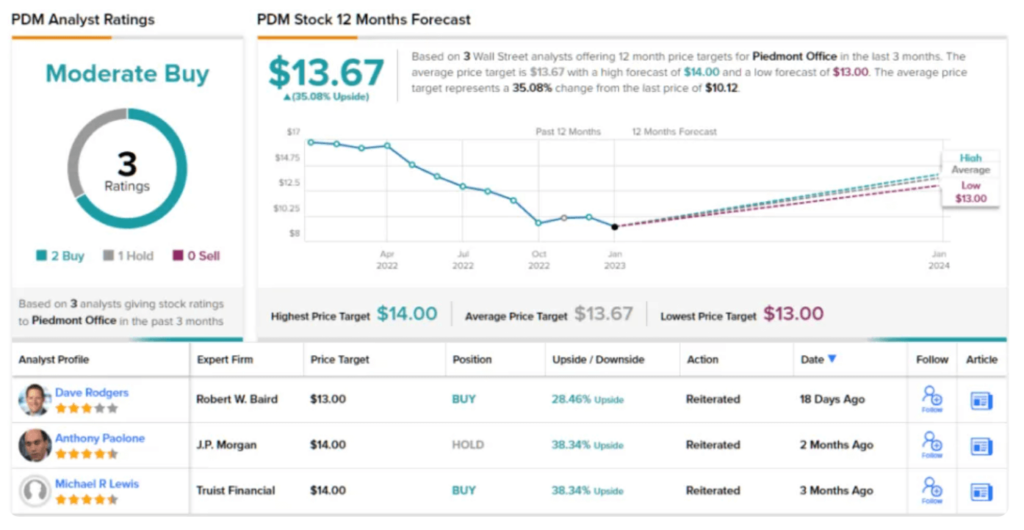
Rodgers goes on to give PDM shares an Outperform (i.e. Buy) rating, with a price target of $13, indicating his confidence in a 28% upside on the one-year horizon.

This stock holds a Moderate Buy rating from the analyst consensus, based on 3 recent reviews that include 2 Buys and 1 Hold. The average price target of $13.67 suggests a 35% upside potential from the current trading price of $10.12.


Source: finance.yahoo.com